
Introduction
Most organisations still deliver training as if information sticks simply because people looked at a slide deck or completed a course.
But brain science says otherwise.
Employees forget up to 70% of new information within 24 hours — and 80% within a month — if there's no reinforcement.
This isn't a motivation problem, or a talent problem, or a culture problem.
It's a biology problem.
And unless your training programme is built around how memory actually works, you're wasting time, money, and attention.
This article explores why the human brain forgets so quickly, drawing on insights from cognitive psychology and neuroscience. We'll explain what the Ebbinghaus Forgetting Curve really means, why your current training isn't sticking, and how modern learning science fixes the problem. You'll discover practical steps you can implement immediately, and learn how SMEs can radically improve retention without increasing workload.
What Is the Ebbinghaus Effect?
In the 1880s, German psychologist Hermann Ebbinghaus conducted the world's first systematic studies of memory. He discovered something that still shocks leaders today:
Memory decays rapidly — most of what we learn is forgotten very quickly unless it is reinforced.
His research led to the creation of the Forgetting Curve, which shows how retention drops over time.
The science:
- • After 20 minutes → you forget 40%
- • After 1 hour → you forget 55%
- • After 24 hours → you forget 70%
- • After a month → you forget 80%
(Referenced across multiple cognitive psychology studies summarised in Melnick, 2020; Murre & Dros, 2015.)
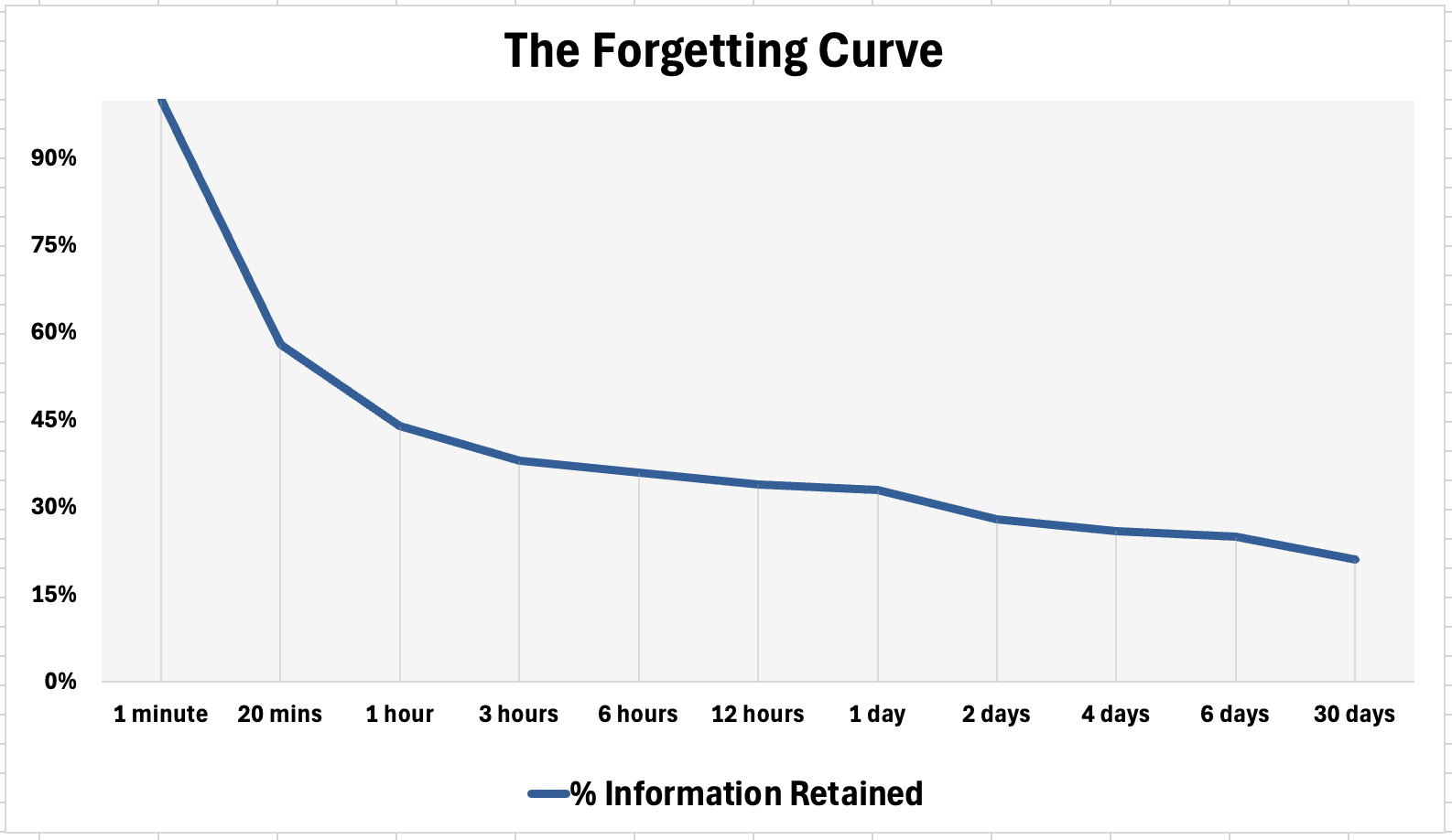
This is not a failure of employees. It's a predictable neurological process.
Why We Forget: The Neuroscience Explained
Cognitive psychology and neuroscience have identified three core reasons:
The brain prioritises efficiency, not storage
The brain is a filtering machine. It tries to keep you alive, not help you pass compliance training. Information is discarded when it feels irrelevant, when it's not connected to previous knowledge, when it's presented passively, or when there are no real-world consequences. We only store what the brain considers "important enough."
Passive learning creates "shallow encoding"
When training is lecture-based, slide-heavy, webinar-style, delivered as a one-time event, or requires only passive clicking, it produces weak neural connections. Neurons need repetition, retrieval, and application to embed memories effectively.
Stress, distractions, and cognitive overload
The modern workplace is a retention killer.
Slack, Teams, email, meetings, switching tasks — it all drains working memory.
Studies from the American Psychological Association show that switching tasks reduces cognitive processing capacity by up to 40%.
Your employees aren't bad learners. Their brains are simply overloaded. See why most training overloads the brain.
The Real Problem: Most Training Is Designed Backwards
Here's the uncomfortable truth:
Most organisations design training based on what they want to say, not how humans actually learn.
That's why compliance training is forgotten immediately, skills training rarely changes behaviour, and managers think "we told them once" is enough. Staff tick the box but don't retain the content, and training feels like admin rather than performance improvement. It's not about effort. It's about poor instructional design.
Why Traditional Training Fails (According to Science)
One-off sessions don't work. A single 60-minute course produces short-term recall, not long-term learning. Without reinforcement, there's no retention — if employees never revisit content, the forgetting curve takes over.
Most training programmes lack retrieval practice. Quizzes, spaced questions, and real-world application deepen memory, but most training never includes them. There's also no spacing effect — spacing learning over days or weeks increases retention dramatically (Cepeda et al., 2006), yet most training dumps everything at once. See our dedicated guide: Why Spaced Repetition Beats Cramming.
Finally, traditional training creates no emotional connection. The brain remembers what it feels, not what it scans through.
So… How Do We Make Training Actually Stick?
Here's the good news: Science has also given us the fix.
Spaced Repetition
Instead of one big training session, break content into short bursts delivered over time. This dramatically improves retention — up to 200% in controlled studies. See our guide to the spacing effect for how to apply it.
Retrieval Practice (Testing Effect)
Asking learners to recall information strengthens neural pathways more than re-reading it. This can take the form of quick quiz questions, scenario-based questions, knowledge checks, or short challenges. See our guide to the testing effect, or use our Course Builder to add knowledge checks directly inside your courses.
Microlearning
Short 3–6 minute modules beat long sessions every time. They fit around work, remove cognitive overload, increase completion rates, and align perfectly with the spacing effect. See Cognitive Load Theory for why.
Real-world Application
Employees retain what they do, what they apply, and what they practice. This means adding practical steps, workflows, or scenarios into learning to create meaningful connections.
Reinforcement Through Nudges
Monthly reminders, quick refreshers, and micro-prompts re-trigger memory and prevent decay. This is why automated LMS reminders matter.
Emotional Engagement
Stories > slides. Real examples > definitions. Consequences > checklists. The limbic system stores emotion-linked memory far more effectively.
Role-based Personalisation
The brain remembers what feels relevant. A finance employee shouldn't get the same training as someone in marketing. Personalisation = retention.
Why This Matters for UK Businesses in 2025
SMEs waste thousands of hours every year delivering training that simply doesn't stick. And with rising compliance requirements, cybersecurity risks, staff turnover, remote and hybrid working patterns, and legal obligations, it's no longer acceptable for training to be forgotten in 24 hours.
Learning needs to work. It needs to be measurable. It needs to impact behaviour.
Retention is the metric. Not completion.
Stop Training That Disappears in 24 Hours
TrainMeUK is built on learning science that combats the forgetting curve. Our platform delivers microlearning, spaced repetition, retrieval practice, and automated reinforcement — ensuring your training makes a lasting impact on behaviour and performance.
Set up TrainMeUK in under a day and transform how your employees learn and retain critical information. No more wasted hours on training that employees forget immediately.
How TrainMeUK Helps Training Stick
TrainMeUK is built around learning science principles. Our platform offers microlearning-ready modules with inline knowledge checks, spaced reinforcement, and role-based training paths. We provide automated reminders, real-world scenarios, SCORM-compliant interactive content, and manager dashboards that track retention — not just completion ticks.
Your training shouldn't disappear within a day. We've built a platform that makes learning unforgettable.
Final Takeaway
If your training programme is built on the idea that employees will "remember what they were told," it's already failing.
The brain needs spacing, retrieval, application, relevance, emotion, and reinforcement. Without these elements working together, information slips away faster than most organisations realise.
Teaching once is information. Teaching repeatedly is behaviour change.
Businesses that understand this outperform those that don't.
If you want your training to stick, design for the brain — not the checklist.
Learning science series
Why employees forget → Why spacing beats cramming → Why testing beats re-reading → Why overload kills learning → Why visuals beat words alone → Why tick-box training fails
Related Articles
Why Traditional Compliance Training Doesn't Change Behaviour
UK breach data shows tick-box training doesn't reduce risk — and what does.
Read More →The Hidden Costs of Poor Onboarding
Learn how effective onboarding reduces turnover and improves retention from day one.
Read More →SCORM vs. Non-SCORM Training
Understand how to choose the right training format for better engagement and retention.
Read More →Frequently Asked Questions
Why do employees forget 70% of training in 24 hours?
Employees forget 70% of training within 24 hours due to the Ebbinghaus Forgetting Curve, a predictable neurological process discovered by German psychologist Hermann Ebbinghaus. The brain prioritises efficiency over storage, discarding information that feels irrelevant, isn't connected to previous knowledge, or is presented passively. Without reinforcement, memory decays rapidly: 40% forgotten after 20 minutes, 55% after 1 hour, 70% after 24 hours, and 80% after a month.
What is the Ebbinghaus Forgetting Curve?
The Ebbinghaus Forgetting Curve, discovered by Hermann Ebbinghaus in the 1880s, shows how memory retention drops over time without reinforcement. It demonstrates that most information is forgotten quickly: 40% after 20 minutes, 55% after 1 hour, 70% after 24 hours, and 80% after a month. This is a predictable neurological process, not a failure of employees. The curve highlights why training must include spaced repetition and retrieval practice to improve retention.
How can I make training stick longer?
To make training stick, use evidence-based learning science strategies: spaced repetition (breaking content into short bursts over time), retrieval practice (quizzes and knowledge checks), microlearning (3-6 minute modules), real-world application, reinforcement through automated reminders, emotional engagement with stories and examples, and role-based personalisation. Traditional one-off sessions fail because they don't account for how memory actually works.
Why does traditional training fail?
Traditional training fails because it's designed backwards - based on what organisations want to say rather than how humans actually learn. One-off sessions, no reinforcement, no retrieval practice, no spacing effect, and passive delivery create shallow encoding with weak neural connections. Studies show that switching tasks reduces cognitive processing by up to 40%, and modern workplace distractions (Slack, Teams, email) drain working memory, making retention even worse.
What is spaced repetition in training?
Spaced repetition is an evidence-based learning technique that breaks content into short bursts delivered over time, rather than one long session. Research shows this dramatically improves retention - up to 200% in controlled studies (Cepeda et al., 2006). Instead of a single 60-minute course, deliver 3-6 minute microlearning modules over days or weeks. This aligns with how the brain forms strong neural connections through repeated exposure and retrieval practice.
Want Training That Actually Sticks?
TrainMeUK is built on learning science principles that combat the forgetting curve. Our platform delivers microlearning, spaced repetition, retrieval practice, and automated reinforcement — ensuring your training makes a lasting impact.
Stop wasting time on training that disappears within 24 hours. Set up TrainMeUK in under a day and transform how your employees learn and retain critical information.