
Introduction
Yes — GDPR training is a legal requirement in the UK. Under UK GDPR (and the Data Protection Act 2018), organisations that handle personal data must ensure staff are appropriately trained and aware of their responsibilities.
UK organisations that handle personal data bear ongoing obligations — not just around secure storage, but around staff awareness, responsibility and accountability.
Training is not optional. While the law does not explicitly say "you must send staff on a 2-hour online course every 12 months," regulatory guidance from Information Commissioner's Office (ICO) makes clear that ongoing awareness-raising and training is a core part of any compliant data protection programme.
The Risk
If you don't train your staff — and can't prove you tried — you're exposing the business to risk, fines, reputational damage, and regulatory scrutiny.
This post unpacks exactly who needs training, what the training must cover, how often it should happen, and how you can evidence it — so your business stays GDPR-compliant in 2025 and beyond. GDPR is one pillar of a wider set of compliance training courses UK employers must deliver.
✅ Who Needs GDPR Training?
- Anybody who handles personal data — not just IT or HR. Under GDPR definitions, "processing" covers collection, storage, sharing, emailing, deleting, or even simple data access.
- That includes staff, contractors, temps, part-time workers — even if they only handle data occasionally.
- For organisations: you must assess data flows and identify who interacts with personal data — then train accordingly.
"The Commissioner would expect an organisation to train employees handling personal data … before an individual is given access to such data."
In short — if personal data touches the employee's workflow, they need training.
📚 What Should GDPR Training Include? (ICO Requirements)
A one-size-fits-all approach doesn't work. Training programmes should be:
Role-based
Cover what's relevant to that employee's data handling (e.g. marketing might need consent & PECR, admin needs record-keeping, HR needs staff data rules).
Comprehensive
For core staff — offer basic data protection principles, data security, handling requests, data breaches, deletion, sharing, and data subject rights.
Documented & Auditable
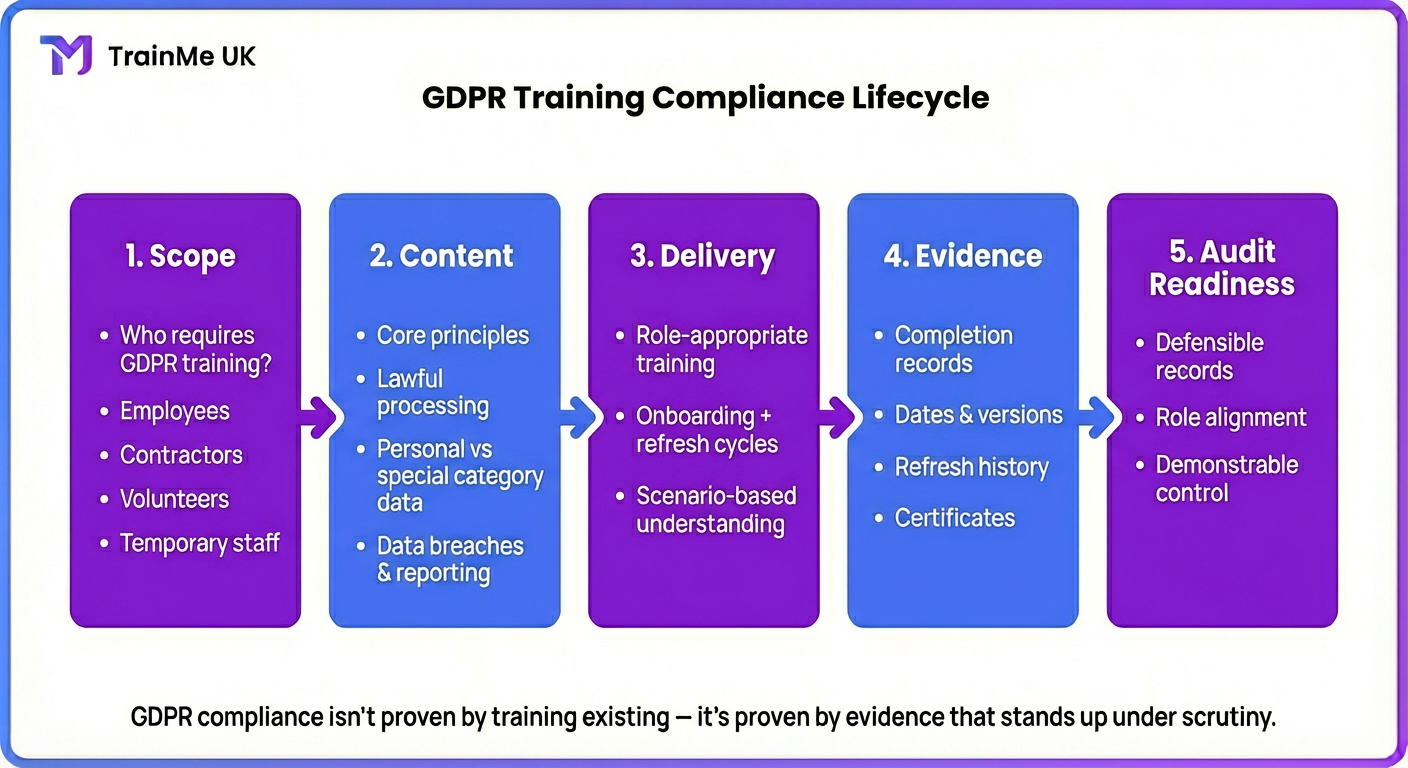
Keep training records, evidence of completion, and a log of who trained, when, and with what materials.
For small businesses, short, focused training sessions (e.g. 30–60 min) can still satisfy obligations — provided they cover the relevant risks and are tracked.
| Topic | Purpose |
|---|---|
| The principles of UK GDPR | Explains lawful, fair, and transparent processing; data minimisation; and storage limitation |
| Recognising and reporting breaches | Teaches staff how to identify and report data breaches quickly |
| Individual rights | Covers access requests, right to erasure, and data portability |
| Data handling and storage | Reinforces correct collection, sharing, and deletion practices |
| Using IT systems securely | Emphasises passwords, phishing awareness, and secure remote working |
| Internal policies and accountability | Connects data protection principles with day-to-day responsibilities |
💡 According to the ICO, around 80% of reported data breaches in the UK involve human error — and phishing remains the most common cause. See our guides to phishing awareness training, social engineering training, and CEO fraud training. Regular training significantly reduces this risk by ensuring staff recognise and respond to threats appropriately.
🔄 How Often Should GDPR Training Be Done?
Because compliance obligations evolve, data-flows change, and staff turnover happens — training must be recurring.
Best-practice guidance agrees:
- Onboarding training — delivered before or immediately when a new hire begins handling personal data.
- Regular refresher training — at least once a year for all staff processing personal data.
- Trigger-based training — whenever internal processes change, you adopt new tools, or the regulations are updated.
Failing to refresh training regularly or after changes is a common compliance weakness.
| Requirement | What the ICO expects |
|---|---|
| Who must be trained | Any employee handling personal data |
| Frequency | Regularly (at least annually, and on role change) |
| Evidence | Completion records, certificates, audit trail |
| Format | Online or in-person, role-appropriate |
🗣 The ICO states: "Staff training and awareness are key measures to ensure compliance with data protection law." — ICO Guidance, 2024
🛡 Why It's Critical — Risks if You Don't Train
Regulatory Fines
Under UK GDPR, enforcement by ICO can be severe, especially if you cannot show organisational measures (training is an obvious one).
Legal Liability
Employees unaware of their obligations are more likely to mishandle data, trigger a breach, or mis-process subject access requests.
Reputational Damage
A data breach can destroy trust with customers, clients, and stakeholders far quicker than you can rebuild it.
Audit Failure
Bodies, clients, or regulators may request training records; if you have none, you lose.
If your business deals with personal data — whatever size — skipping training is simply reckless.
🎯 How to Run GDPR Training That Actually Works
Here's a practical, minimal-waste approach (especially for SMEs) that satisfies regulatory expectations and builds real data-protection awareness:
| Step | Action |
|---|---|
| 1 | Map data flows & identify risks — Understand what data you hold, who handles it, and the risk associated with processing. |
| 2 | Segment staff by role & risk — Create groups: high-risk (HR, IT, Finance), medium-risk (marketing, admin), low-risk (others) — tailor training accordingly. |
| 3 | Onboard & first-time training — Deliver baseline data protection training before staff handle data. Keep a sign-off or digital record. |
| 4 | Annual refresher + change-based updates — Update training if regulations or internal processes change. Re-run refresher annually. |
| 5 | Keep training records & logs — Maintain audit-ready logs: who, when, what training, what version of materials. |
| 6 | Update materials regularly — Ensure content reflects latest UK-specific legal requirements (post-Brexit UK GDPR, Data Protection Act, ICO guidance). |
| 7 | Embed data-protection culture — Promote privacy awareness through reminders, role-based prompts, and integrate it into policies & processes. |
📋 How to Evidence GDPR Compliance
Demonstrating compliance is just as important as achieving it. When the ICO investigates a data breach or reviews a complaint, it will often ask an organisation to provide proof that its staff have received appropriate GDPR training. This helps establish whether the breach resulted from a lack of awareness or a procedural failure — a key factor in determining regulatory action.
The ICO may request this evidence following:
- A self-reported data breach
- A complaint from an individual
- A formal audit
- Sector-wide reviews
- Procurement due diligence in industries handling sensitive information
In these cases, organisations are expected to show a structured, ongoing approach to training — including when sessions took place, what topics were covered, and how completion was tracked.
A strong audit trail might include:
- A central register of staff participation and completion dates
- Summaries or copies of training materials
- Automated refresher reminders and overdue alerts
- Certificates or digital reports verifying completion
📊 ICO Case Example
In several enforcement actions between 2021–2024, the ICO noted that organisations unable to prove staff training had taken place faced higher penalties, even when the original breach was accidental. Executive impersonation attacks — CEO fraud training is your evidence defence when payroll or HR data is extracted — can trigger breach notifications where training records make a material difference to the outcome.
Maintaining clear, accessible records not only satisfies regulatory requirements but also provides a strong defence in the event of an incident.
✔️ How Training Meets UK GDPR Obligations (Legal Basis)
- The law (Data Protection Act 2018 / UK GDPR) requires organisations to implement "appropriate technical and organisational measures". Training is explicitly referenced in guidance on staff accountability — including data breach training for employees so staff know how to recognise and escalate incidents after they occur.
- The Information Commissioner's Office (ICO) guidance expects all-staff training, regular refresher courses, role-based training, and documented training programmes as part of a compliant data-protection regime.
This means training isn't "nice to have." It's a defensible legal requirement.
Get Your Free GDPR Compliance Toolkit
GDPR Training Compliance Checklist
30-point ICO-aligned checklist with audit-ready framework
GDPR Training Policy Template
8-10 page policy: frequency, roles, evidence requirements
Training Records Template
Excel-compatible tracker for completions and renewals
Free GDPR SCORM Course (SCORM 1.2)
Ready for any LMS — Moodle, Totara, Cornerstone
📧 Instant access. No spam.
Best Practices for 2025
To meet compliance expectations efficiently:
1. Embed GDPR into Onboarding
Ensure new staff complete GDPR training as part of induction, before they handle any personal data.
2. Automate Refresher Cycles
Use automated reminders to ensure consistency and prevent training from lapsing.
3. Keep Training Relevant
Make it short, role-specific, and updated annually to reflect regulatory changes.
4. Centralise Reporting
Maintain a single source of truth to prove compliance instantly when asked.
Many UK businesses are now choosing to automate this process through a Learning Management System (LMS) to avoid manual tracking and improve audit readiness. If you are comparing platforms that include GDPR and other UK compliance courses as standard, see our LMS with built-in compliance courses comparison.
✅ Conclusion — Don't Treat GDPR Training as a Checkbox
Many UK SMEs view GDPR training as a compliance nuisance — a box to tick. That's exactly the wrong mindset.
GDPR training should be a foundational pillar of your data-protection strategy. It's how you:
- • Turn legal text into operational reality
- • Empower staff to handle data safely
- • Protect yourself from regulatory fines, breaches, and liability
- • Demonstrate accountability and build trust with customers
Ignoring it is only a matter of time before it becomes a major problem.
If you run a business that handles personal data — regardless of size — you need a regular, auditable, role-based training programme, updated with regulatory changes, and backed by documented evidence.
In 2025, that's not "best practice." It's business survival.
When GDPR Training Becomes an Audit Risk
Many UK businesses believe they're compliant because staff completed some form of GDPR training.
In reality, audits and investigations rarely fail on intent — they fail on evidence.
If you can't quickly show: who was trained, when they were trained, what content they completed, and why it was appropriate for their role — then training becomes a liability, not a defence.
Related Articles
Compliance Audit Preparation
Learn how to prepare for compliance audits and achieve 94% pass rates with proper documentation.
Read More →Staying Audit-Ready All Year
Maintain compliance readiness without extra admin burden.
Read More →Top 5 Compliance Training Failures
Avoid the most common compliance training mistakes that cost UK SMBs time, money, and reputation.
Read More →Frequently Asked Questions
Is GDPR training legally required for UK businesses?
Yes. Under UK GDPR and the Data Protection Act 2018, organisations that handle personal data must ensure staff are appropriately trained. The ICO expects documented, ongoing training as part of your accountability obligations.
Who needs GDPR training in a UK business?
All staff who handle personal data need GDPR training — this includes HR, sales, marketing, finance, and customer service teams. Roles with higher data access (e.g. data controllers, DPOs) require more in-depth training.
How often should GDPR training be done?
The ICO recommends GDPR training at least annually, plus refreshers when there are significant process changes or data incidents. New starters should complete training as part of onboarding.
What happens if UK businesses don't provide GDPR training?
Failure to train staff is a contributing factor in ICO enforcement actions. Fines can reach £17.5 million or 4% of global annual turnover under UK GDPR. Beyond fines, untrained staff are a leading cause of data breaches.
What should GDPR training cover?
GDPR training should cover: the principles of UK GDPR, lawful bases for processing, individual rights (access, erasure, portability), how to handle data breaches, and role-specific responsibilities. Training must be documented and auditable.