
When “Mandatory Training” Feels Unclear
If you've ever felt unsure whether your organisation is training too much "just in case" or too little to be safe in an audit, you're not alone.
"Mandatory training" sounds like a fixed list. In UK practice, it is usually a duty to ensure people are competent for the risks of their role — not a requirement to buy one specific course for everyone.
That misunderstanding creates real exposure. UK government research shows cyber incidents remain common for organisations, with phishing still the dominant pattern among affected businesses.
When training does not match actual risk, outcomes usually drift into one of two extremes:
- Over-training: high completion volume, low engagement, weak evidence quality
- Under-training: high-risk roles missed, inconsistent records, weaker defence after incidents
This is not a checklist of courses. It is a guide to deciding what applies where, why differences are justified, and how to defend those decisions in an audit.
If you first need the baseline list that applies to most organisations, see Mandatory Training Requirements for UK Businesses. This sector guide builds on that baseline and focuses on assignment logic.
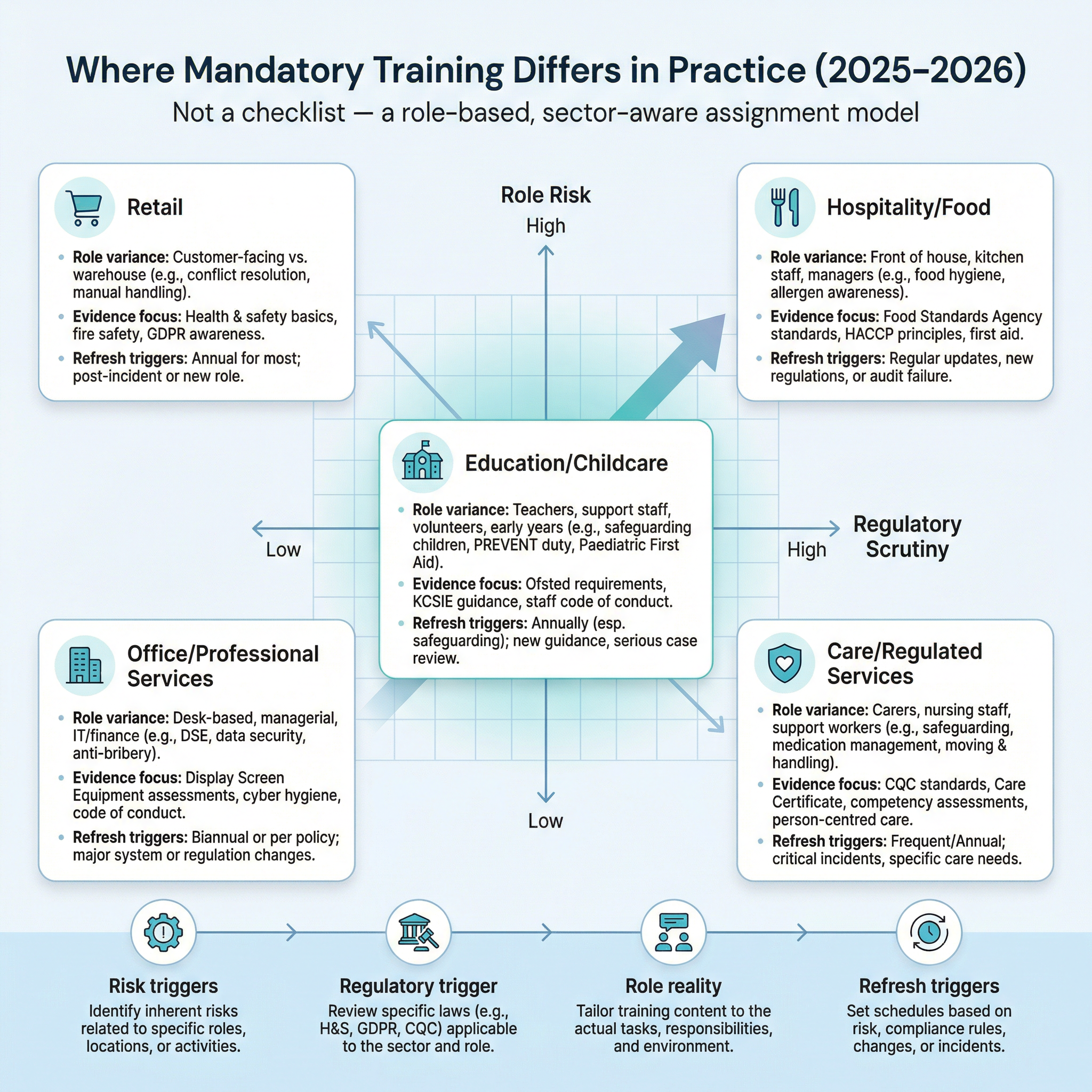
In this article you'll learn:
- What "mandatory training" means in real UK regulatory terms
- Where sectors genuinely differ — and where they do not
- The common over-training and under-training patterns auditors spot
- A practical 4-step test to make training decisions defensible
A Critical Starting Point: What “Mandatory” Really Means in the UK
In most sectors, regulators do not say "everyone must complete course X". Instead, they expect employers to provide appropriate information, instruction, training and supervision for real workplace risks.
- HSE expectations focus on adequate instruction, training and supervision.
- ICO accountability expectations focus on relevant, accurate and up-to-date staff training with programme review.
What makes training feel sector-specific in practice is usually four factors:
- Nature of risk (for example: vulnerable people, food safety, public safety, high-volume personal data)
- Intensity of scrutiny (inspection likelihood, enforcement history, regulatory maturity)
- Consequence of failure (harm, enforcement, contract risk, reputation impact)
- Evidence standard (how clearly decisions are intentional, current, and role-matched)
The biggest operational failure is rarely "no training exists." It is usually training drift: assignments are made once and not revisited when roles, locations or responsibilities change.
Overview: Where Decisions Change by Sector
The table below focuses on decision logic: where role variation is highest, what auditors inspect first, what evidence is expected, and when refreshes should be triggered.
| Sector | Role Variance That Matters | Auditor / Inspector Focus | Refresh Triggers |
|---|---|---|---|
| Retail | Cashier vs stockroom vs shift lead vs duty manager | Training reflects real supervision and site-specific risk | Store transfer, shift lead changes, incident trend |
| Hospitality / Food-led | Front-of-house vs kitchen vs supervisor | Role depth for hygiene/allergen controls and process ownership | Menu change, process update, near miss, complaint |
| Education / Childcare | Teacher vs site staff vs contractor / volunteer | Safeguarding role fit and access-based assignment decisions | Duty change, setting move, guidance updates |
| Care / Regulated Services | Support worker vs meds admin vs supervisor | Competence evidence for higher-risk delegated tasks | Task expansion, rota changes, medication process change |
| Office / Professional Services | Admin vs HR / finance / operations with elevated data risk | Data-handling role fit and phishing escalation readiness | System access change, policy update, incident pattern |
Training Matrix Example (Role-Based Assignment)
This is the practical layer most businesses miss: translating "sector expectations" into role-level assignment logic that you can evidence.
| Sector | Role | Assignment Logic | Evidence to Keep | Refresh Trigger |
|---|---|---|---|---|
| Retail | Cashier | Customer-facing baseline + payment/data handling | Completion + short knowledge check | POS/process update |
| Retail | Duty Manager | Baseline + incident escalation + supervisory responsibilities | Completion + role rationale + escalation drill record | Role change / site transfer |
| Education | Teacher | Safeguarding depth tied to pupil-facing duty | Completion + safeguarding role statement | Policy/guidance update |
| Education | Visiting Contractor | Access-based minimum with supervision controls | Access rule + induction completion evidence | Access scope change |
| Care | Support Worker | Baseline care competencies for assigned tasks | Completion + competency sign-off | Task/rota change |
| Care | Medication Supervisor | Enhanced assignment for medication oversight and escalation | Completion + delegated authority evidence | Medication process change / incident |
Sector-by-Sector: Where Businesses Commonly Over- or Under-Train
Retail and Customer-Facing Environments
Retail sits in a mixed-risk model: public interaction, physical premises, lone working, cash handling, and in some cases food controls.
Over-training pattern
Applying one identical training package to every store and role even when risk differs by layout, equipment, and supervisory responsibility.
Under-training pattern
Temporary staff, shift leads and cross-site movers are missed because assignments do not follow role changes.
Hospitality and Food-Led Businesses
This is one of the clearest areas for role-specific expectations because food handling and allergen controls affect public safety directly.
Common mistake
Assuming one food-safety module fits everyone. Kitchen teams, supervisors, and front-of-house staff usually need different depth and refresh triggers.
Education and Childcare Settings
Duty-of-care expectations are high, and safeguarding training is central to inspection confidence.
Over-training trap
One uniform safeguarding package for all roles, which can dilute relevance for high-responsibility staff.
Under-training trap
Peripatetic staff, contractors, volunteers, and operations teams are excluded despite meaningful access and contact points.
Care and Regulated Services
In care settings, role boundaries can expand informally. Training design must keep pace with what staff are actually being asked to do.
Key risk
Task expansion without formal role update. Organisations then struggle to evidence why higher-risk work was assigned without updated competence proof.
Office-Based and Professional Services SMBs
Office risk may look lower at first glance, but data handling, phishing exposure, and incident escalation responsibilities still require deliberate training design.
Under-training pattern
GDPR awareness is treated as light-touch admin training even for HR, finance, operations and support roles that handle sensitive personal data.
The 4-Step Test to Decide What’s “Mandatory” in Your Business
Use this framework to replace guesswork with decisions you can explain under scrutiny.
- Risk triggers: What can realistically go wrong in this role or location?
- Regulatory trigger: Are there explicit duties or statutory guidance in scope?
- Role reality: What do people actually do week-to-week, beyond job titles?
- Refresh triggers: What operational events require training updates?
For data protection, the ICO is clear that training should remain relevant and up to date and that programmes should be reviewed over time.
Quick Wins (This Week)
- Build a role + location + responsibility matrix (not "everyone gets everything").
- Set reassignment logic for movers, leavers, temporary and cross-site staff.
- Create a minimal evidence pack: completion record, module version, policy link, knowledge check.
Longer-Term (Next Quarter)
- Introduce quarterly review of mandatory training by role to prevent drift.
- Track exceptions with reasons so differences are clearly intentional.
- Add phishing simulations and micro refreshers to reflect dominant cyber risk patterns.
The Audit Lens: What Matters Most
Auditors rarely ask whether everyone completed the same content.
They ask whether differences are intentional, defensible, and current.
If you can show a role-location matrix, refresh triggers, and clear evidence history, your position is usually strong even when training differs across teams.
Because training drift often starts when people join, move teams, or pick up new responsibilities, onboarding structure has a direct impact on ongoing compliance quality.
📥 Free Download: Onboarding Toolkit for UK SMBs
Standardise your onboarding and avoid one-size-fits-all training mistakes:
30/60/90 Day Onboarding Plan — Structured plan with goals, activities, check-ins, and success measures
Manager Onboarding Checklist — Complete checklist covering pre-start, day one, first week, and 90-day activities
New Starter Questionnaire — Structured feedback form for week 1, week 4, and week 12 check-ins
Welcome Email Template — Professional email template ready to copy and paste into Outlook
📧 Instant access. No spam. Professional resources for UK businesses.
Mandatory Training by Sector FAQs (UK)
Common questions about sector-based mandatory training requirements in the UK. Click a question to expand.
Is mandatory training the same for every UK business?
Not usually. Core legal duties apply widely, but what is appropriate depends on risk and role. Regulators typically assess whether your approach is proportionate and current, not whether everyone completed identical courses.
Is GDPR training mandatory for all staff?
Not as one universal course. The ICO expects training and awareness to be relevant and up to date for staff with personal-data responsibilities. Role fit matters more than blanket assignment.
Do we need fire safety training in the UK?
For most workplaces, yes. Fire safety duties apply broadly and employees should receive adequate fire safety instruction, especially at induction and when arrangements change.
How often should mandatory training be refreshed?
Usually based on triggers rather than fixed annual dates alone: role changes, incidents, policy/process changes, new equipment, and audit findings. The strongest approach is one you can justify with evidence.
Sources
- UK government: Cyber Security Breaches Survey
- HSE: Training requirements
- ICO accountability framework: training and awareness
- Food Standards Agency: Food hygiene guidance
- Food Standards Agency: Allergen guidance
- Department for Education: Keeping Children Safe in Education
- Prevent duty (Counter-Terrorism and Security Act 2015)
- UK fire safety responsibilities
- NCSC: Phishing guidance
Related Articles
Mandatory Training Requirements UK (2025–2026 Guide)
Core legal and operational mandatory training requirements for UK businesses.
Read More →Food Safety Training Requirements for UK Businesses
What food-led businesses are expected to train, evidence, and refresh.
Read More →GDPR Training Requirements for UK Businesses
How to keep data protection training relevant, current, and auditable.
Read More →