
"Who is responsible for training compliance?"
This sounds like a simple question.
In UK organisations, it almost never is.
Ask five people and you'll usually get five different answers. Directors assume HR owns it. HR expects managers to enforce it. Managers believe the system will handle it. Employees assume someone else is accountable.
On paper, this is often described as shared responsibility.
In practice, that phrase is one of the most common root causes of training compliance failure.
UK regulators do not accept shared assumptions. They expect clear accountability, defined ownership, and evidence that responsibility is exercised in a consistent, repeatable way. When those things are missing, training compliance becomes fragile – even when completion rates look healthy.
This article explains where responsibility actually sits under UK law, how it should operate day to day, and why organisations that fail to separate accountability from ownership often discover the problem during audits, inspections, or incidents.
Why Responsibility Matters More Than Most Organisations Realise
Training compliance rarely fails because organisations ignore it.
It fails because responsibility is unclear, fragmented, or assumed rather than explicitly owned.
When responsibility isn't clearly defined:
- Training decisions drift
- Refresh cycles weaken
- Role changes go unreflected
- Evidence slowly disconnects from reality
By the time this becomes visible – often during an audit or regulatory review – confidence collapses quickly under questioning.
Understanding who is responsible, in what sense, and with what authority is foundational to maintaining control.
The Legal Position: Accountability Cannot Be Delegated
Under UK law, ultimate responsibility for training compliance always sits with the organisation – and by extension, its senior leadership.
This applies across:
- Health & safety legislation
- UK GDPR and the Data Protection Act 2018
- Safeguarding and sector-specific regulation
Tasks can be delegated. Accountability cannot.
When training is missing, inappropriate, or poorly evidenced, regulators do not accept explanations such as:
- "HR didn't tell us"
- "Managers were meant to handle it"
- "The system didn't flag it"
Responsibility remains with the organisation's leadership.
This is why training compliance is not an administrative issue.
It is a governance issue.
Where Organisations Get Confused
Most problems arise because organisations blur two very different concepts.
Legal accountability
Answers: Who is answerable if training fails?
Operational ownership
Answers: Who ensures training actually happens correctly, consistently, and on time?
They are not the same thing.
When they are treated as interchangeable, gaps appear – and those gaps tend to grow over time.
The Four Real Responsibility Layers in Training Compliance
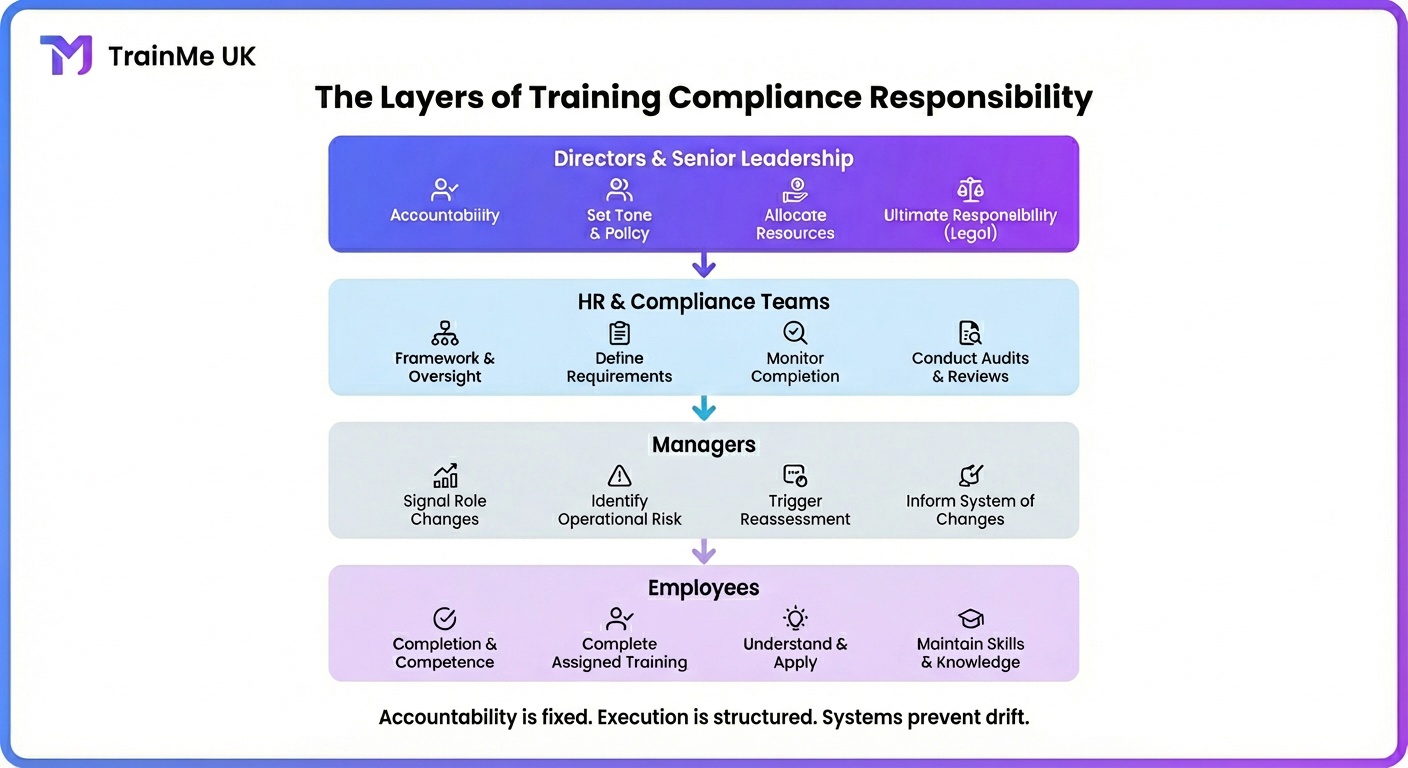
In well-run organisations, training compliance is distributed – but only when boundaries are explicit and enforced.
1️⃣ Directors and senior leadership (Accountability)
Senior leaders carry ultimate accountability. Their role is to ensure:
- Appropriate training frameworks exist
- Assignment logic reflects real organisational risk
- Oversight and reporting mechanisms are in place
- Evidence is defensible under scrutiny
They are not expected to manage training day to day. They are expected to ensure the system works.
2️⃣ HR / Compliance teams (Framework and oversight)
HR typically owns the compliance framework, including:
- Defining mandatory training requirements
- Aligning policy with regulatory expectations
- Monitoring overall compliance posture
- Supporting audits, investigations, and reviews
What HR cannot realistically do – especially at scale – is manually track every role change, site variation, or operational nuance.
When HR is expected to do this without structural support, compliance becomes brittle.
3️⃣ Managers (Operational signal, not system control)
Managers are closest to real-world risk. They:
- Understand what roles actually involve
- See changes first
- Recognise when responsibilities expand or shift
However, when managers are made responsible for compliance without authority, tooling, or consistency, outcomes vary widely.
Managers should signal change – not manually enforce compliance.
4️⃣ Employees (Completion, not compliance design)
Employees are responsible for completing assigned training honestly and on time.
They are not responsible for deciding:
- What training they require
- When it should refresh
- Whether it is sufficient
That responsibility always sits higher up the organisation.
Why "Shared Responsibility" Often Means No Responsibility
Many organisations believe shared responsibility spreads risk.
In reality, it spreads assumptions.
Without a clear system enforcing alignment:
- Role changes go unnoticed
- Training assignments are inherited by default
- Exceptions accumulate
- Evidence degrades over time
When auditors ask how responsibility is exercised in practice, informal arrangements are difficult to explain – and impossible to defend confidently.
Shared responsibility without ownership is how compliance fails.
What Good Responsibility Looks Like in Practice
Organisations that manage training compliance well separate accountability from execution – but connect both through structure and systems.
In practice, this means:
- Leadership retains accountability
- HR defines requirements and oversight
- Managers trigger change through role movement
- Systems enforce consistency automatically
In modern organisations, this alignment is often supported by platforms like TrainMeUK, where training is assigned dynamically based on job role, department, and location. As people move, their training requirements move with them – without relying on individual memory or interpretation.
Importantly, this allows organisations to demonstrate not just who is responsible, but how responsibility is exercised in practice.
Responsibility isn't removed.
It becomes explicit, auditable, and enforceable.
Why Manual Ownership Breaks Down Over Time
Even well-intentioned organisations struggle to maintain clarity as they grow.
Manual approaches depend on:
- Accurate communication
- Consistent interpretation
- Timely action
- Thorough documentation
Each dependency introduces risk. Over time, small gaps compound into systemic weakness.
This is why many organisations feel compliant – until they are asked to explain how responsibility actually operates under scrutiny.
The Audit Perspective on Responsibility
Auditors don't ask:
"Who was supposed to do this?"
They ask:
"How does the organisation ensure this always happens?"
If responsibility is informal, undocumented, or person-dependent, auditors see fragility.
If responsibility is embedded into structure and systems, auditors see control.
The Real Shift Organisations Need to Make
Training compliance does not require more ownership.
It requires clear accountability, defined operational ownership, and systems that prevent drift as organisations change.
When responsibility is explicit and enforced structurally, training stops being a recurring problem and becomes a stable control.
This is the operational philosophy behind modern compliance platforms like TrainMeUK, where responsibility is aligned to organisational structure rather than individual memory.
Final Thought
If training compliance relies on everyone "doing their bit", it relies on luck.
If it relies on clear accountability, defined ownership, and systems that keep training aligned as roles change, it becomes resilient.
For deeper context, see:
- Mandatory Training Requirements for UK Businesses
- Training Records & Audit Readiness
- How UK SMBs Can Finally Get Control of Their Training
Training Compliance Responsibility FAQs (UK)
Common questions about who is responsible for training compliance in UK businesses. Click on any question to expand the answer.
Who is responsible for training compliance in UK businesses?
Under UK law, ultimate responsibility for training compliance always sits with the organisation and its senior leadership. While tasks can be delegated, accountability cannot. Directors and senior leaders carry ultimate accountability for ensuring appropriate training frameworks exist, assignment logic reflects real risk, oversight mechanisms are in place, and evidence is defensible under scrutiny.
Can training compliance responsibility be delegated?
Tasks can be delegated, but accountability cannot. Under UK law, if training is missing, inappropriate, or poorly evidenced, regulators do not accept explanations such as HR didn't tell us or managers were meant to handle it. Responsibility remains with the organisation's leadership. Training compliance is not an administrative issue — it is a governance issue.
What is the difference between accountability and operational ownership in training compliance?
Legal accountability answers who is answerable if training fails — this sits with senior leadership. Operational ownership answers who ensures training actually happens correctly, consistently, and on time — this is typically distributed across HR, managers, and systems. They are not the same thing. When treated as interchangeable, gaps appear.
What do auditors look for regarding training compliance responsibility?
Auditors don't ask who was supposed to do this. They ask how does the organisation ensure this always happens? If responsibility is informal, undocumented, or person-dependent, auditors see fragility. If responsibility is embedded into structure and systems, auditors see control. Organisations must show not just who is responsible, but how responsibility is exercised in practice.
Why does shared responsibility often fail in training compliance?
Shared responsibility often means no responsibility. Without a clear system enforcing alignment, role changes go unnoticed, training assignments are inherited by default, exceptions accumulate quietly, and evidence degrades over time. When auditors ask how responsibility is exercised in practice, informal arrangements are difficult to explain — and impossible to defend confidently.
Related Articles
Mandatory Training Requirements for UK Businesses (2025–2026)
A clear breakdown of mandatory training requirements for UK businesses. See what training is legally required, how often it must be refreshed, and who it applies to.
Read More →Training Records & Audit Readiness: What UK Auditors Actually Expect
Audits rarely fail because training didn't happen. They fail when organisations can't prove it. Learn what UK auditors expect from training records.
Read More →How UK SMBs Can Finally Get Control of Their Training in 2025
A practical guide for real UK organisations who are tired of messy spreadsheets, inconsistent training, and last-minute audit panic.
Read More →