
Stop managing compliance training on spreadsheets. Here's what UK employers need to evidence — and how to run it without the admin headache.

TrainMeUK Team
Compliance LMS specialists helping UK SMBs automate training assignment, tracking, and renewal. Our platform integrates with Azure AD and covers the core UK compliance topics employers need to evidence.
Follow on LinkedIn →Employee compliance training in the UK is not one single legal requirement. Employers need to evidence a mix of direct statutory training, regulator expectations, statutory defence measures, and internal risk controls.
TL;DR — What you need to know
- UK employers need to evidence training across health & safety, fire safety, data protection, equality and harassment prevention, anti-bribery, and cyber security awareness. Some of this is directly required by law; some is expected through regulator guidance, statutory defences, sector rules, or recognised security frameworks.
- Enforcement is real. HSE completed 246 criminal prosecutions in 2024/25, with over £33m in fines awarded. The ICO can fine up to £17.5m or 4% of worldwide turnover for the most serious UK GDPR breaches.
- Tracking is the hard part. Most SMBs know what training they need — they just can't prove who's done it, when, and whether renewals are current.
- Automation fixes this. A platform that syncs with your directory, auto-assigns courses, and exports audit reports removes most of the admin.
What is employee compliance training?
Compliance training is any structured learning that ensures your employees understand and follow the legal, regulatory, or internal rules that apply to their role.
There are two types worth distinguishing:
Statutory training is legally required by UK legislation. Failing to provide it exposes you to prosecution, fines, or civil liability. Health & safety induction training is the clearest example.
Mandatory training is required by your organisation or sector guidance — not always by primary legislation — but still essential for safe and ethical operations. Cyber security awareness often sits here unless you operate in a regulated sector.
Most SMBs need both. The critical point for auditors is not the label — it is whether you can show what training was required, assigned, completed, and renewed.
In short: Some employee compliance training is directly required by law, such as health and safety and fire safety. Other areas — including data protection, anti-bribery, equality and harassment prevention, and cyber security awareness — are best understood as legal, regulatory, or risk-control expectations that employers need to evidence properly.
For a full breakdown of statutory vs sector-specific requirements, see our mandatory training requirements guide.
What compliance training do UK employers need to evidence?
This is the question HR managers ask most. The honest answer is layered: some duties are direct statutory requirements; others are accountability, defence, or sector-control expectations — but all of them need evidence when something goes wrong.
1. Direct statutory duties
Health & Safety — The Health and Safety at Work etc. Act 1974 requires employers to provide adequate information, instruction, training, and supervision. HSE guidance is clear that workers need clear instructions and adequate training. It must be refreshed when roles or risks change.
Fire Safety — The Regulatory Reform (Fire Safety) Order 2005 requires the responsible person to ensure employees receive adequate fire safety training when first employed — normally at induction, during working hours — and repeated when circumstances change. See GOV.UK fire safety guidance.
2. Accountability and regulatory expectations
UK GDPR / Data Protection — The ICO does not set a simple standalone rule that every employee must complete an annual GDPR course. But under UK GDPR accountability and Article 32 security obligations, induction and refresher training for staff handling personal data is an expected control. Insufficient or out-of-date training can undermine compliance with Articles 5(1)(f) and 32. See our guide to GDPR training expectations under UK law.
Cyber Security Awareness — No single UK Act universally mandates cyber training for every employer. NCSC guidance treats staff awareness as important, and sector regulators (FCA, CQC, Ofsted) and frameworks such as Cyber Essentials often treat it as a baseline control. In regulated sectors it is effectively required; elsewhere it is a recognised risk-control expectation. See our cyber security training guide for UK SMEs.
3. Legal defence and prevention areas
Anti-Bribery — The Bribery Act 2010 creates a corporate offence of failing to prevent bribery. The statutory defence is having "adequate procedures" in place. GOV.UK/MoJ guidance lists communication and training as one of the six principles for bribery prevention — training supports the defence; it is not a fixed annual statutory course for every business.
Equality & Harassment Prevention — Employers must take reasonable steps to prevent sexual harassment under current law. From October 2026, the Employment Rights Act 2025 raises this to "all reasonable steps" and expands third-party harassment liability (Acas guidance). Training is one reasonable step — not the whole duty — but it is increasingly central to demonstrating prevention.
Summary: UK compliance training at a glance
| Training Type | Basis / expectation | Who It Applies To | Typical Refresh Frequency |
|---|---|---|---|
| Health & Safety | Direct statutory duty — HSWA 1974 | All employees | On induction + when roles/risks change |
| Fire Safety | Direct statutory duty — Fire Safety Order 2005 | All employees | At induction; repeat when circumstances change |
| UK GDPR / Data Protection | Accountability / security obligation — UK GDPR, DPA 2018; ICO expects induction + refreshers | Staff handling personal data | At appropriate intervals (annual is common) |
| Equality & Harassment Prevention | Preventative duty — Equality Act 2010; ERA 2025 ("all reasonable steps" from Oct 2026) | All employees | Regularly; more frequent from Oct 2026 |
| Anti-Bribery | Adequate-procedures defence — Bribery Act 2010; MoJ six principles | All employees (risk-based depth) | Commonly every 1–2 years |
| Cyber Security Awareness | Regulatory / good-practice expectation — NCSC; sector regulators where applicable | All employees (stronger in regulated sectors) | Annually is common good practice |
What happens if you can't evidence compliance training?
The fines are real. HSE completed 246 criminal prosecutions in 2024/25, with over £33m awarded in fines. The ICO can issue penalties up to £17.5m or 4% of worldwide annual turnover for the most serious UK GDPR infringements. In 2025, the ICO fined Capita entities a combined £14m (£8m to Capita plc and £6m to Capita Pension Solutions Ltd) following a breach affecting 6.6m people. The FCA reported over £186m in fines during 2024/25, including 37 Final Notices.
Separately, employment tribunals can uplift compensation by up to 25% where an employer failed to take reasonable steps — rising to all reasonable steps from October 2026 — to prevent harassment. Training alone will not satisfy that duty, but absent evidence of prevention measures weakens your position.
Regulators don't just respond to the incident itself. They assess whether you had demonstrable controls in place beforehand. Training records are part of that picture — especially where accountability, adequate procedures, or sector supervision apply.
Evidence beats intention.
If you cannot show who completed what, when, and whether it was refreshed, your compliance position is weaker than you think.
The real problem isn't knowing what's required — it's tracking it
Most HR managers at SMBs know roughly what compliance training their team needs. That's not the hard part.
The hard part is proving it.
Who completed the GDPR refresher last quarter? Which new starters haven't finished their fire safety induction? Whose health & safety certificate expired three months ago and nobody noticed?
These are the questions that trip up SMBs during audits. And the answers are usually buried in:
- A spreadsheet that was last updated by someone who left
- Email threads chasing staff who "meant to get round to it"
- A shared drive with certificates that may or may not be current
- A training provider's portal that doesn't talk to anything else
In our experience, HR teams at 10–200 person businesses often spend several hours every month on training admin — chasing completions, updating records, sending reminders, and compiling reports. That's before anyone's actually learned anything — and UK breach data suggests generic annual modules rarely change what people do; see why traditional compliance training doesn't change behaviour.
No audit trail. When an inspector asks for evidence of training, "we did it in a Teams call" isn't an answer. You need timestamped completion records, per employee, per course, with certificates — and ideally evidence they can recall what they learned, not just that they clicked through. See why testing beats re-reading.
Renewals fall through the gaps. Annual refreshers don't remind themselves. Without automated alerts, renewals get missed — and you only find out when something goes wrong. The same content delivered as one annual blast is also what learning science says employees forget fastest; see why spaced repetition beats cramming and why comprehensive modules overload the brain.
No visibility across teams. If you have multiple departments, sites, or a mix of office and remote staff, a spreadsheet gives you no real-time picture of where your compliance rate actually stands.
Typical spreadsheet tracking
| Name | GDPR | Fire | H&S | Due |
|---|---|---|---|---|
| J. Smith | Y | ? | Y | ??? |
| A. Patel | NO | NO | Y | OVERDUE |
| (left co.) | Y | Y | Y | 2023 |
| Last updated: March 2024 — Sarah | ||||
Still tracking compliance training manually?
TrainMeUK gives you live completion tracking, renewal reminders, certificates, and audit-ready exports from one dashboard. Book a short walkthrough and see what your current spreadsheet process could look like automated.
How to build a compliance training programme for your team
A solid compliance training programme doesn't need to be complicated. Five steps covers it.
Step 1 — Map your legal obligations by role
Not every employee needs every course. A warehouse operative needs different training from a finance manager. Start with a role-by-role matrix: what does each person legally need, and how often?
Step 2 — Assign courses to the right people
Once you know who needs what, assign courses — ideally automatically, based on job role or department. New starters should be enrolled on day one, not week three.
Step 3 — Set renewal dates and automated reminders
Every compliance course has a shelf life. Build renewal dates into your system and set automated reminders at 30, 14, and 7 days before expiry. No manual chasing required.
Step 4 — Track completion in real time
You need a live view of who's done what. Not a monthly export. Not a spreadsheet you update manually. A real-time dashboard that shows completion rates by team, department, or site.
Step 5 — Export audit-ready reports before inspections
When HSE, the ICO, or your insurer asks for evidence of training, you should be able to produce a complete, timestamped report in one click. Not in three days.
Why online compliance training works for UK SMBs
Online compliance training is not better because it is digital. It is better because it creates evidence automatically. Classroom training made sense when your whole team was in one building on the same shift — but even then, sign-in sheets rarely survive an audit.
A compliance course online removes the scheduling problem: staff complete training during quieter periods, between tasks, or from home. More importantly, completion, timestamps, and certificates are recorded without someone updating a spreadsheet.
The benefits stack up quickly for SMBs running employee compliance training online:
- Completion is tracked automatically — no manual sign-in sheets or certificate chasing
- Certificates are generated instantly on passing, with timestamps and employee details
- Works across multiple sites or remote teams — everyone gets the same course, the same standard
- Scales without extra cost — adding a new starter to a compliance course online takes seconds, not days
- Consistent quality — every employee gets the same content, not a different version depending on who delivered the classroom session
Online employee compliance training also makes renewals far easier to manage. When a course is due for refresh, the system re-enrols the employee automatically. No HR intervention needed.
For UK SMBs running compliance training courses across a mixed workforce, online delivery isn't a compromise. It's the practical choice. Compare platforms in our best compliance training software UK review.
How TrainMeUK handles compliance training — automatically
Most platforms make you do the work. TrainMeUK does it for you.
Here's what that looks like in practice:
Azure AD sync — enrolment from day one. Where Azure AD integration is enabled, new employees can be enrolled automatically on the compliance courses relevant to their role — reducing the risk of someone starting without recorded mandatory training.
Automated reminders — less manual chasing. Renewal dates are tracked per employee, per course. Reminders can go out automatically at 30, 14, and 7 days before expiry. Staff get nudged. Managers get visibility. Renewals are much harder to miss.
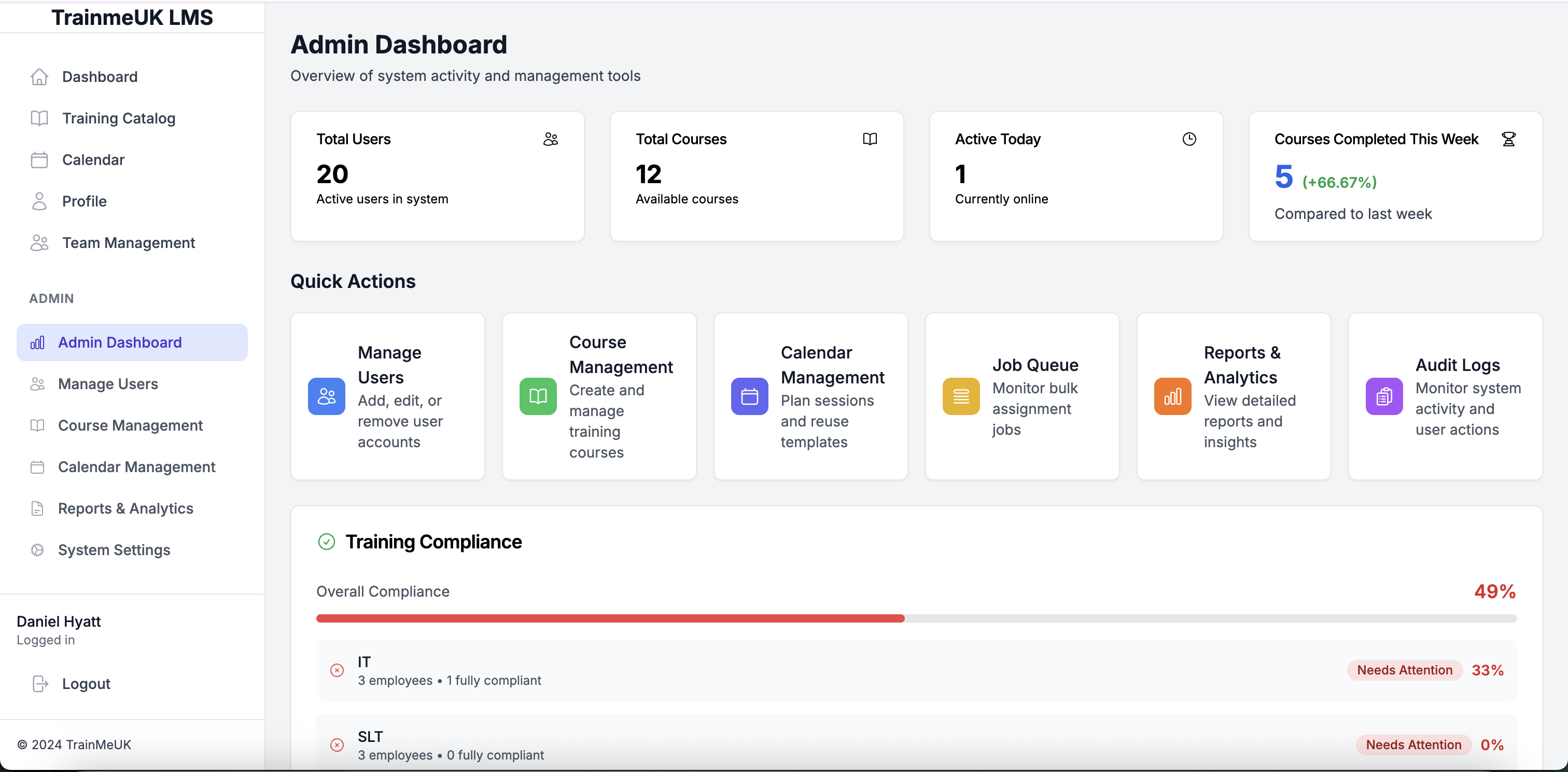
Real-time dashboard — compliance rate at a glance. One screen shows you exactly where your organisation stands: overall compliance rate, completions by department, outstanding renewals, and overdue training. No report-building. No spreadsheet.
Audit-ready exports — one click before an inspection. When a regulator asks for evidence, you export a full, timestamped training record — by employee, by course, by date — in seconds. HSE, ICO, FCA, or your insurer: whoever's asking, you're ready.
UK-specific compliance training courses. The course library covers the core topics employers typically need to evidence: GDPR and data protection, health & safety, fire safety, cyber security awareness, equality and harassment prevention, and anti-bribery — aligned to UK law and guidance.
The routine work runs in the background: assignments, reminders, renewals, certificates, and evidence exports. Your team still owns compliance — they just stop rebuilding it manually every month.
Designed to help teams maintain high compliance rates · Reduce hours of manual training admin each month · Automated renewal alerts make missed refreshers much harder
Our take — Daniel Hyatt, Founder, TrainMeUK
The most avoidable compliance failure I see at UK SMBs isn't ignorance of the law — it's assuming a spreadsheet counts as evidence. Organisations deliver training; they just can't prove who completed what, when, or whether renewals are current. That gap only surfaces during an audit or after an incident, when it's too late to reconstruct records credibly.
Expert insights
Three questions we hear from HR and compliance leads building employee compliance training programmes at UK SMBs.
What's the most common compliance gap when a new SMB client onboards?
New starters without day-one assignments. HR sends a welcome pack, someone mentions fire safety in passing, and data protection gets covered "when they have time." Three months later, half the team still has no recorded completion — and nobody noticed because the spreadsheet wasn't updated. Where Azure AD integration is in place, automatic enrolment on day one with role-based rules removes that dependency on someone remembering to add a row.
Has the Employment Rights Act 2025 changed what SMBs are asking to train on?
Yes — sharply. The shift from "reasonable steps" to "all reasonable steps" on harassment prevention, effective October 2026, has made equality and dignity-at-work training a board-level conversation. Clients who treated it as a one-off tick-box are now asking for shorter, more frequent refreshers and manager-specific modules. Third-party harassment liability is also driving demand for customer-facing and contractor-facing training — not just internal staff.
What does an ICO/HSE inspector actually look for as training evidence?
Individual, dated completion records — not a policy that says you train people. Inspectors want to see who was trained, on what, when, and whether refreshers happened on schedule. For HSE, role-specific hazard training matters: a generic video isn't enough if the role involves manual handling or COSHH. For the ICO, they ask whether training happened before staff accessed personal data and whether you can show ongoing awareness, not a one-off induction from years ago. A CSV export with timestamps beats a folder of unsigned attendance sheets every time.
Key takeaways
-
1.
UK employers must evidence training properly — across direct statutory duties (health & safety, fire safety) and accountability, defence, and sector-control expectations (data protection, anti-bribery, harassment prevention, cyber awareness).
-
2.
Enforcement is substantial. HSE reported 246 prosecutions and over £33m in fines in 2024/25. ICO penalties can reach £17.5m or 4% of worldwide turnover. The Capita entities were fined a combined £14m in 2025.
-
3.
Knowing what's required is only half the battle. The real risk for SMBs is failing to track, evidence, and renew training — especially across growing or distributed teams.
-
4.
A structured compliance training programme — mapped by role, assigned automatically, tracked in real time, and reported on demand — is the only reliable way to stay compliant at scale.
-
5.
Online compliance training courses solve the scheduling and tracking problems that make classroom training impractical for most SMBs. Automation handles the rest.
Frequently asked questions
Common questions about employee compliance training for UK SMBs.
Is compliance training legally required for all UK employees?
How often should compliance training be refreshed?
Can online training satisfy UK legal requirements?
What's the difference between statutory and mandatory training?
What employee compliance training do UK SMBs need in 2026?
How does TrainMeUK help with compliance training?
Useful sources
- Health and Safety at Work etc. Act 1974 — HSE guidance
- UK GDPR guidance and resources — ICO
- Fire safety legislation: guidance for those with legal duties — GOV.UK
- Equality Act 2010 guidance — GOV.UK
- Employment Rights Act 2025 — Acas
- Bribery Act 2010 guidance — GOV.UK
- FCA Annual Report 2024/25
Ready to automate compliance training for your team?
Stop chasing completions. Stop updating spreadsheets. Stop worrying about the next audit.
TrainMeUK handles your entire compliance training programme — automatically.