
Introduction
When most people want to learn something, they re-read it. Go over the notes again. Watch the training video a second time. Re-read the policy document. It feels like the obvious way to make information stick.
It's one of the least effective things you can do.
Decades of research show that testing yourself on material — actively pulling it back out of your memory — produces dramatically stronger long-term retention than reviewing the same material again. The quiz isn't just a way to measure learning. The quiz is learning.
This is the testing effect, sometimes called retrieval practice, and it's one of the most robust findings in cognitive psychology. The twist that makes it so important for training: people consistently believe the opposite of what's true. Re-reading feels productive and builds confidence; testing feels harder and less rewarding. Yet when you measure what's actually retained weeks later, the testers win clearly.
This article explains what the testing effect is, walks through the landmark study that demonstrated it, and shows how to apply it in workplace training without turning every course into an exam. It's the natural partner to two ideas we've covered before — the Ebbinghaus Forgetting Curve (why we forget) and the Spacing Effect (how timing fixes it).
What Is the Testing Effect?
The testing effect is the finding that retrieving information from memory strengthens that memory more than simply re-studying the same information.
The key word is retrieving. When you read something again, you recognise it — it feels familiar, so you assume you know it. But recognition is passive and weak. When you try to recall something without looking — answer a question, explain a concept, write down what you remember — you force your brain to reconstruct the memory, and that effortful reconstruction is what makes it stronger.
In short: every time you successfully pull a piece of knowledge out of your head, you make it easier to pull out next time. Re-reading doesn't give you that workout. Testing does.
This is why a quick knowledge-check after a training module isn't a formality. It's doing real work — arguably more learning happens in the recall than happened during the original study.
The Study That Made the Case
The definitive demonstration came from Henry Roediger and Jeffrey Karpicke at Washington University, published in Psychological Science in 2006 under the title "Test-Enhanced Learning."
The setup was simple and realistic. Students read short prose passages on general science topics — the kind of educational material that mirrors workplace learning far better than memorising word lists. Then they were split: one group re-studied the passage; the other group took a recall test on it (writing down everything they could remember, with no feedback). Both groups spent the same amount of time. Everyone then took a final test either 5 minutes, 2 days, or 1 week later.
The results contained the crucial twist:
- After 5 minutes, the re-study group did better — recalling 81% versus 75% for the tested group. Re-reading wins in the very short term.
- After 2 days, the pattern flipped: the tested group recalled 68% versus just 54% for the re-study group.
- After 1 week, the gap held firm: the tested group retained 56% while the re-study group dropped to 42%.
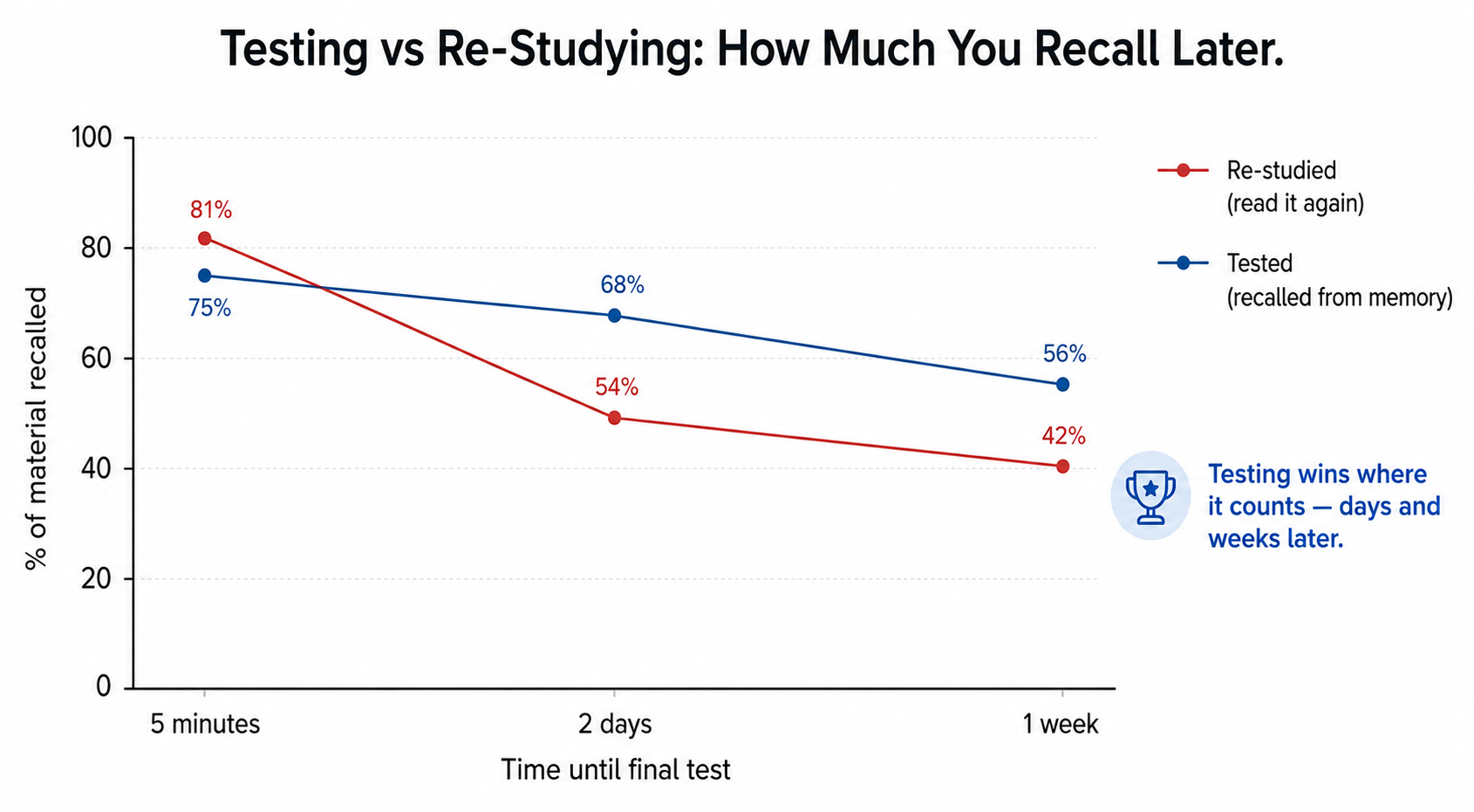
Read that again, because it's the whole point. In the short term, re-reading looks better — which is exactly why people trust it. But over the timescales that actually matter for retaining training, testing produced substantially more durable memory.
There was one more striking detail. The re-study group felt more confident they'd remember the material — even though they remembered less. The method that produces the most confidence is not the method that produces the most learning.
The Neuroscience: Why Retrieval Strengthens Memory
Why does the act of recalling do more than re-exposure? A few mechanisms are at work.
Retrieval is reconstruction, not playback
Memory isn't a recording you replay. Each time you recall something, your brain actively rebuilds it from its component parts — and the act of rebuilding strengthens and reorganises the connections involved. Re-reading skips this work entirely; the information just washes over you.
Effort is the active ingredient
Successful retrieval that takes a bit of effort produces the biggest gains. This is one of psychology's "desirable difficulties" — the struggle to recall is uncomfortable, but that discomfort is the sign that learning is happening. Easy, fluent re-reading produces no such effort and no such gain.
Retrieval creates better cues for next time
Pulling information out of memory builds and reinforces the mental "routes" you'll use to find it again later. The more retrieval routes a memory has, the more reliably it can be accessed under pressure — which is exactly what you want when an employee needs to apply training in a real situation.
Why We Resist the Thing That Works
If testing works so well, why is re-reading still everyone's default? Because of a powerful illusion.
Re-reading feels good. The material is familiar, it flows easily, and that fluency tricks us into thinking we've mastered it. This is the fluency illusion — we mistake the ease of recognising something for the ability to recall it. The Roediger and Karpicke result captures it perfectly: the re-readers were more confident and less able.
Testing feels like the opposite. It surfaces what you don't know, which is uncomfortable. People often walk away from a quiz feeling they learned less — when in fact they learned more. This mismatch between how a method feels and how well it works is the single biggest reason effective learning techniques get ignored.
For anyone designing training, the lesson is uncomfortable but clear: the format that gets the warmest reaction in the room is often the least effective, and the format people grumble about may be doing the most good.
Types of Retrieval Practice
Testing doesn't have to mean a high-stakes exam. Almost any activity that makes someone recall information from memory counts. Useful forms include:
- Low-stakes quizzes — short, frequent, no career consequences. The goal is practice, not judgement.
- Scenario-based questions — "A customer asks X — what do you do?" forces retrieval and application at once.
- Knowledge checks inside a course — a question or two after each section, before moving on.
- Free recall / brain-dumps — asking someone to write down everything they remember about a topic, no notes.
- Teaching it back — explaining a concept to a colleague is retrieval in disguise, and a strong one.
The common thread is simple: the learner produces the answer from memory, rather than recognising it on a page.
How to Use Testing Without Making Staff Hate Quizzes
Testing has an image problem at work — it feels like assessment, scrutiny, a trap. The fix is to change how it's used, not whether it's used:
- Keep it low-stakes. Frequent, no-pressure checks for learning, not pass/fail gates that create anxiety.
- Make it formative. Use the results to reinforce, not to rank. A wrong answer is a cue for a refresher, not a black mark.
- Build it in, don't bolt it on. A short check at the end of each section feels natural; a single big exam at the end feels like an ordeal.
- Test little and often. Frequent small retrievals beat one large one — and they pair beautifully with spacing.
- Give feedback. Knowing whether you were right corrects errors and strengthens the correct memory.
Done well, retrieval practice stops feeling like an exam and starts feeling like a normal, low-friction part of learning — because that's exactly what it is.
Why This Matters for UK Businesses in 2026
For UK SMEs, most workplace training ends with completion, not comprehension. An employee watches a module, clicks "finish," and a record is created — but no one has checked whether anything was actually retained. The forgetting curve then does its work, and within weeks the knowledge is gone.
Retrieval practice closes that gap on two fronts. First, it makes the training stick — the recall itself strengthens memory, so employees retain more of what they're meant to know. Second, it gives you genuine evidence of understanding rather than mere attendance. For compliance and safety-critical training especially, the difference between "they completed it" and "they can demonstrably recall and apply it" is the difference that matters to regulators, auditors, and incident investigators. See what counts as training evidence in a UK audit.
The metric that counts is what people can retrieve when it matters — not what they clicked through.
Build Training People Actually Remember
TrainMeUK weaves knowledge checks throughout each course and finishes with a quiz of 5–10 questions — multiple choice, true/false, scenario simulations, picture hotspots and more — so every course turns passive viewing into the active recall that strengthens memory. Short, focused modules keep each check sharp and relevant.
Set up TrainMeUK in under a day and start building training that tests understanding, not just attendance.
How TrainMeUK Helps
TrainMeUK is built for retrieval practice rather than passive viewing. Courses are short and focused — typically 15–20 minutes — with knowledge checks woven throughout, so learners are recalling as they go rather than just clicking ahead. Each course also ends with a quiz of around 5–10 questions, and those questions span a range of formats: multiple choice, true/false, scenario simulations, picture hotspots and more. That variety matters: different question types prompt different kinds of recall, from simple fact retrieval to applying knowledge in a realistic situation — exactly the active, effortful recall that strengthens memory.
Larger topics are broken into their core components, which keeps each check focused on one area at a time. You design the questions; the platform makes recall a natural part of every course.
Final Takeaway
The testing effect overturns one of our most basic assumptions about learning. Re-reading feels like the responsible thing to do, but it builds confidence far faster than it builds memory. Retrieving information — quizzing, recalling, explaining — is harder, feels less satisfying, and works far better.
The evidence is unusually clear and unusually old, yet it remains widely ignored, precisely because the most effective method is the one that feels least effective.
If you want training to be remembered, don't just deliver it and review it. Make people retrieve it.
Reviewing tells you it feels familiar. Retrieving proves you actually know it.
Learning science series
Why employees forget → Why spacing beats cramming → Why testing beats re-reading → Why overload kills learning → Why visuals beat words alone → Why tick-box training fails
Related Articles
Why Employees Forget 70% of Training in 24 Hours
The forgetting problem retrieval practice helps solve.
Read More →Why Spaced Repetition Beats Cramming
Spaced retrieval is the strongest combination of all.
Read More →Why Traditional Compliance Training Doesn't Change Behaviour
UK breach data shows tick-box training doesn't reduce risk — and what does.
Read More →Frequently Asked Questions
What is the testing effect?
The testing effect is the finding that retrieving information from memory — through quizzes, recall, or explaining a concept — strengthens that memory more than simply re-reading or re-studying the same material. It is one of the most reliable findings in cognitive psychology. The key mechanism is effortful recall: actively reconstructing a memory strengthens it, whereas passive re-reading produces only weak, short-lived familiarity. In short, taking a test is not just a way to measure learning — it is a powerful way to produce it.
Is it better to re-read notes or test yourself?
Testing yourself is substantially better for long-term retention. In a landmark 2006 study by Roediger and Karpicke, re-reading produced slightly better recall after just 5 minutes (81% vs 75%), but testing won clearly on delayed tests — 68% vs 54% after two days, and 56% vs 42% after a week. Re-reading feels more effective and builds more confidence, but that confidence is misleading. If you want to remember something days or weeks later, retrieval practice beats re-reading.
Why does testing improve memory more than studying?
Retrieving information from memory is an active reconstruction, not a passive replay. Each time you successfully recall something, your brain rebuilds and strengthens the connections involved, and reinforces the mental routes used to access it later. This effortful retrieval is a "desirable difficulty" — the struggle is what produces the learning. Re-reading skips this work, which is why it feels easy but produces weaker, shorter-lived memory.
Why does re-reading feel more effective than it is?
Re-reading creates a "fluency illusion." Familiar material flows easily, and we mistake that ease of recognition for the ability to recall the information later. In the Roediger and Karpicke study, the group that re-studied actually felt more confident they would remember — yet they remembered less than the group that was tested. People consistently confuse the comfortable feeling of fluency with genuine learning, which is why effective techniques like retrieval practice are so often overlooked.
How can I use retrieval practice in workplace training without it feeling like an exam?
Keep it low-stakes and frequent rather than high-pressure and occasional. Use short knowledge checks inside each course section, scenario-based questions ("a customer asks X — what do you do?"), and brief recall prompts, and treat wrong answers as cues for a refresher rather than a mark against the employee. Give feedback so correct memories are reinforced. Used this way, testing becomes a natural, low-friction part of learning rather than a stressful assessment — and it pairs especially well with spaced delivery.
Want Training That Tests Understanding, Not Just Attendance?
TrainMeUK supports inline knowledge checks in short, focused courses, so recall practice is part of the learning — not an afterthought.