
Introduction
There's a common belief in workplace training that more is better. A thorough induction covers everything in one go. A "comprehensive" compliance module leaves nothing out. A packed slide deck demonstrates how much ground was covered.
The brain doesn't work that way — and trying to teach it everything at once teaches it almost nothing.
Human working memory — the mental workspace where new information is held and processed — is astonishingly small. It can hold only a handful of new items at a time, and only for seconds. Pour more in than it can handle and it doesn't store the overflow; it drops everything. A course that tries to cover too much, too densely, can end up teaching less than a short, focused one.
This is the core insight of Cognitive Load Theory, one of the most influential ideas in modern instructional design. This article explains what cognitive load is, the surprising limits of working memory, the three types of load that compete for it, and exactly how to design training that respects those limits instead of fighting them. It builds on the Ebbinghaus Forgetting Curve: if forgetting is the symptom, cognitive overload is often the cause.
What Is Cognitive Load Theory?
Cognitive Load Theory (CLT) was formulated by educational psychologist John Sweller in the late 1980s. At its heart is a simple, powerful claim:
Learning fails when the demands placed on working memory exceed its capacity.
The theory grew out of Sweller's research on problem-solving, where he noticed something counterintuitive: searching for solutions consumed so much mental effort that learners had little capacity left to actually absorb the underlying patterns. They were busy, but they weren't learning.
The framework distinguishes between two memory systems. Working memory is tiny and fragile — the place where you consciously think about new information right now. Long-term memory is effectively unlimited — the vast store of everything you already know. Learning is the act of moving knowledge from the tiny store into the huge one, by building organised mental structures called schemas. Anything that clogs up working memory before that transfer can happen is the enemy of learning.
In other words: the bottleneck isn't how much your employees can eventually know. It's how much they can process at once on the way there.
How Working Memory Actually Works
Here's the number that surprises most people. Working memory can hold only about four chunks of new information at a time.
You may have heard the more famous figure — "seven, plus or minus two" — from psychologist George Miller's celebrated 1956 paper. For decades that was the rule of thumb. But later research revised the estimate downward: when you strip out tricks like rehearsal and grouping, the true capacity for genuinely new, unconnected items is closer to four. Either way, the headline is the same and it's brutal: the workspace is tiny, and it empties in seconds unless the information is actively used or connected to something already known.
This is why a dense, fast-moving training session fails so reliably. By the time slide three arrives, slide one has already fallen out of working memory — not because the learner wasn't paying attention, but because there was physically nowhere to keep it.
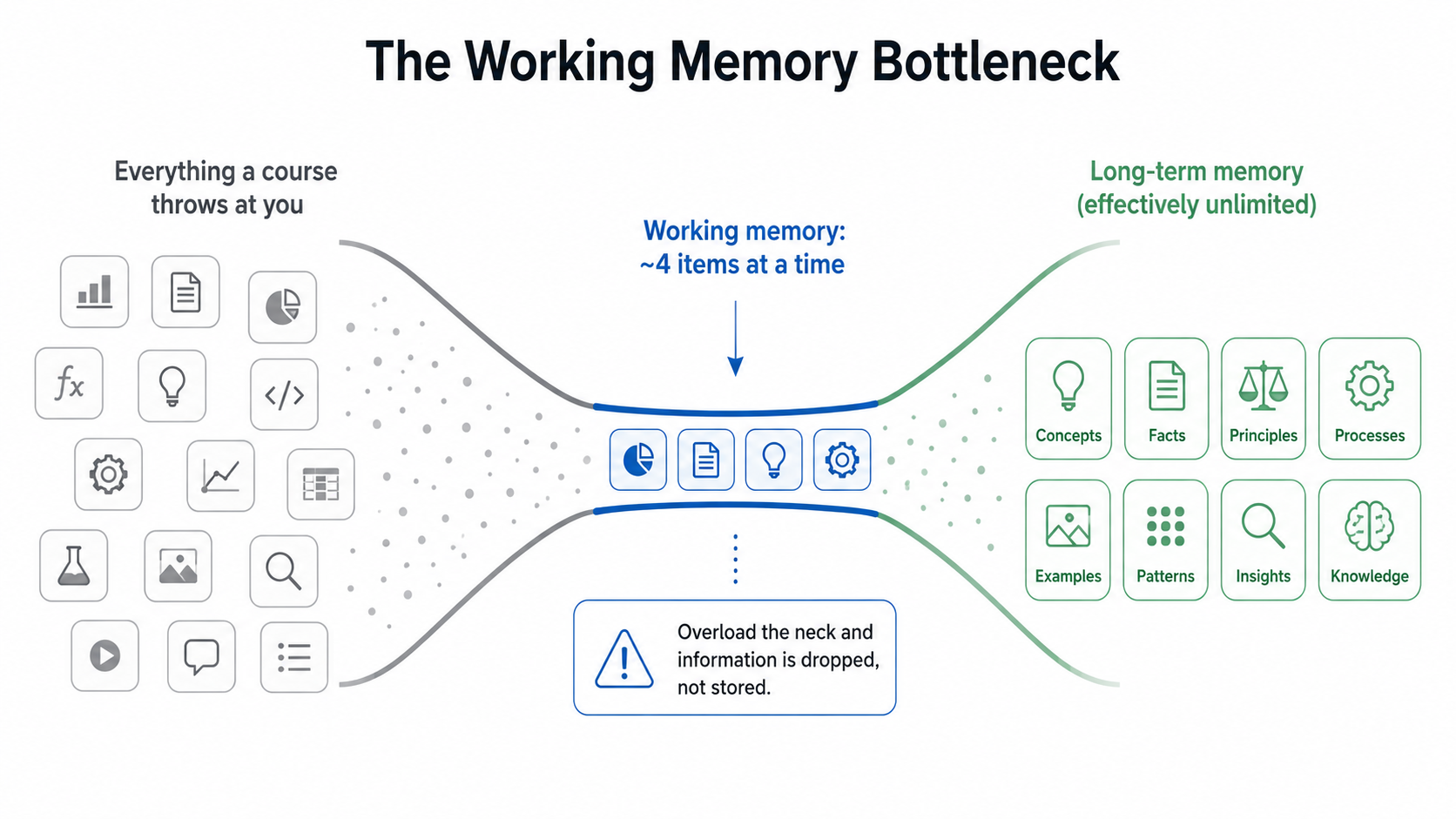
The practical implication is stark. You cannot fix overload with motivation, repetition, or better attention. You fix it by reducing how much the brain has to hold at once.
The Three Types of Load
Not all cognitive load is bad. CLT identifies different types, and the goal isn't to eliminate load — it's to spend a limited budget wisely. The classic framework names three:
Intrinsic load is the inherent difficulty of the material itself. Some topics are simply complex, with many parts that interact. You can't remove intrinsic load without removing content — but you can manage it by sequencing and breaking material into stages. Crucially, intrinsic load depends on the learner: what's hard for a novice is easy for an expert who already has the schemas.
Extraneous load is wasted effort created by how the material is presented — clutter, confusing layouts, irrelevant detail, having to flip between sources. This load contributes nothing to learning. It's pure overhead, and it can be cut close to zero with better design. This is the type you attack first.
Germane load is the productive effort of actually building schemas — the "good" work of learning. Traditionally treated as a third, separate source, it was redefined by Sweller in 2010 as the working-memory resources devoted to handling intrinsic load, rather than an independent category. Many textbooks still teach the older three-source version, so you'll see both — but the practical lesson is unchanged.
The strategy that follows is simple and durable: cut extraneous load to free up capacity, manage intrinsic load through sequencing, so that more of the learner's limited budget goes to the productive work of learning.
The Hidden Killers of Extraneous Load
Because extraneous load is the type you can actually eliminate, it's worth knowing what creates it. The usual culprits in workplace training:
- Dense, text-heavy slides that ask learners to read and listen at once — the two channels compete and both suffer.
- Split attention — when a diagram and its explanation are separated, or a video and its key text sit apart, forcing the brain to hold one while hunting for the other.
- Redundancy — narration that repeats on-screen text word for word, doubling the processing for no gain.
- Irrelevant extras — decorative images, background music, "engaging" flourishes that add cognitive cost without adding learning.
- Too much at once — cramming a broad topic into a single unbroken session, with no chance to consolidate before the next idea arrives.
None of these feel like mistakes. Most look like effort and thoroughness. But each one quietly spends working-memory capacity that should have gone to actual learning.
How to Design Low-Load Training
The fixes follow directly from the theory. The aim is always the same: protect the learner's tiny working-memory budget.
- Chunk it. Break broad topics into small, focused pieces, each covering one idea. This is the single highest-impact move.
- Sequence from simple to complex. Build foundations first so later material has existing schemas to attach to, lowering its effective intrinsic load.
- Cut the clutter. Strip slides and screens back to what's essential. Whitespace isn't wasted space — it's reduced load.
- Signal what matters. Highlight the key point so attention isn't spent figuring out where to look.
- Use worked examples. For novices, showing a fully worked solution imposes far less load than asking them to problem-solve from scratch.
- Pair words and visuals well. Use a diagram with spoken explanation rather than a diagram plus a wall of text — that uses two channels instead of overloading one (see why words and visuals beat words alone).
- Avoid redundancy. Don't narrate text that's already on screen verbatim. Say it or show it, not both identically.
Every one of these does the same job from a different angle: less to hold at once means more capacity to actually learn.
The Microlearning Connection
If you've read our piece on the Ebbinghaus Forgetting Curve, the chunking principle should feel familiar. Cognitive Load Theory is the deeper reason microlearning works.
Short, focused modules aren't just easier to fit around a busy day — they respect the architecture of working memory. A 15-minute module on one clear topic keeps the number of new items within the budget the brain can actually handle. A two-hour "everything" session blows straight past it. Breaking a large subject into its core components, one focused module at a time, isn't a stylistic preference; it's the design that matches how the brain learns.
And it compounds with the other principles we've covered: low-load modules are also easier to space out over time (the Spacing Effect) and to build retrieval practice into (the Testing Effect). Get the load right first, and the rest works better.
Why This Matters for UK Businesses in 2026
UK SMEs often equate a "good" training course with a "complete" one — everything an employee might need, delivered in a single comprehensive session. Cognitive Load Theory explains why that instinct backfires. The more you cram in at once, the less is retained, because the bottleneck isn't the volume of content but the rate the brain can process it.
For compliance and safety training, this is more than an efficiency point. A dense annual module that overloads working memory produces a completion record and very little retained understanding — which is precisely the gap that matters when an employee actually has to apply the knowledge, and the gap auditors and regulators care about. Focused, well-designed, low-load training isn't a "nice to have"; it's the difference between training that's been delivered and training that's been learned.
The lesson for any SME without a dedicated L&D team is reassuring: you don't need more content or more polish. You need less clutter and smaller pieces.
Design Training the Brain Can Actually Absorb
TrainMeUK courses are built around focused, low-load learning. Each course runs about 15–20 minutes and covers one clear area, with larger topics broken down into their core components — so you're working with the limits of working memory, not against them. Less clutter, smaller pieces, better retention.
Set up TrainMeUK in under a day and start delivering training designed for how people actually learn.
How TrainMeUK Helps
TrainMeUK is designed around the principle at the heart of Cognitive Load Theory: keep each piece of learning focused so the brain isn't overloaded. Courses are short — typically 15–20 minutes — and built around a single clear area rather than trying to cover everything at once. Larger, more complex topics are deliberately broken down into their core components, so each module stays within the working-memory budget a learner can actually handle. This chunked, one-thing-at-a-time structure is exactly what the theory prescribes, and it makes content easier to absorb, complete, and retain.
You decide what each focused module covers; the structure keeps cognitive load low by design.
Final Takeaway
Cognitive Load Theory reframes a basic assumption about training. The goal was never to cover the most material — it was to get material into people's long-term memory. And the route there runs through a working memory that can only hold about four new things at a time.
More content, denser slides, longer sessions: these feel like thoroughness, but they overload the very bottleneck that learning has to pass through. Less clutter, smaller chunks, and clean sequencing aren't shortcuts — they're how learning actually happens.
If your training tries to teach everything at once, the brain learns almost nothing. Teach one thing at a time, and it sticks.
Learning science series
Why employees forget → Why spacing beats cramming → Why testing beats re-reading → Why overload kills learning → Why visuals beat words alone → Why tick-box training fails
Related Articles
Why Employees Forget 70% of Training in 24 Hours
Overload is one of the biggest reasons forgetting happens.
Read More →Why Spaced Repetition Beats Cramming
Low-load modules are far easier to space out over time.
Read More →Why Traditional Compliance Training Doesn't Change Behaviour
Where the learning-science cluster meets real-world compliance failure.
Read More →Frequently Asked Questions
What is Cognitive Load Theory?
Cognitive Load Theory, developed by educational psychologist John Sweller in the late 1980s, holds that learning fails when the demands placed on working memory exceed its limited capacity. Because working memory can only process a small amount of new information at once, instruction that presents too much, too densely, overloads the system and prevents learning. The theory guides instructional design toward reducing unnecessary load so that the learner's limited mental capacity goes toward genuinely absorbing the material.
How many things can working memory hold at once?
Working memory can hold only about four chunks of genuinely new information at a time, and only for a matter of seconds unless that information is actively used or connected to existing knowledge. The more famous figure of "seven, plus or minus two" came from George Miller's 1956 paper, but later research revised the estimate downward once strategies like rehearsal and grouping are accounted for. Either way, the practical point is the same: the mental workspace for new information is very small, which is why dense training overwhelms it.
What are the three types of cognitive load?
The three types are intrinsic, extraneous, and germane load. Intrinsic load is the inherent difficulty of the material, which can be managed through sequencing but not removed without cutting content. Extraneous load is wasted effort created by poor presentation (clutter, split attention, redundancy) and can be cut close to zero with better design. Germane load is the productive effort of building mental schemas; in 2010 Sweller redefined it as the resources devoted to handling intrinsic load rather than a separate source, though older materials still treat it as a distinct third type.
Why does "comprehensive" training often fail?
Comprehensive training fails because it overloads working memory. Trying to cover everything in one dense session pushes far more new information at the learner than the brain can process at once — and when working memory is exceeded, the overflow isn't stored, it's lost. The result is a course that feels thorough but teaches little. Counterintuitively, a short, focused course covering one clear area can produce more lasting learning than a long one that covers everything.
How do I reduce cognitive load in training?
The most effective steps are to chunk broad topics into small, single-idea pieces; sequence material from simple to complex so later content has foundations to build on; strip out clutter and irrelevant extras; signal what matters so attention isn't wasted; use worked examples for novices; and pair visuals with spoken explanation rather than overloading one channel with text and narration at once. The unifying aim is to reduce how much the brain must hold simultaneously, freeing capacity for actual learning.
Want Training Designed for How People Actually Learn?
TrainMeUK delivers short, focused courses — typically 15–20 minutes, with larger topics broken into their core components — so learning stays within the limits of working memory and is easier to retain.