
Introduction
Most workplace training happens in one go. A two-hour induction. An annual compliance refresher. A single afternoon workshop. Everything is delivered at once, the box is ticked, and everyone moves on. Cognitive Load Theory explains why that pattern overloads working memory before the forgetting curve even kicks in.
There is a better way — and it has been sitting in the research for over a century.
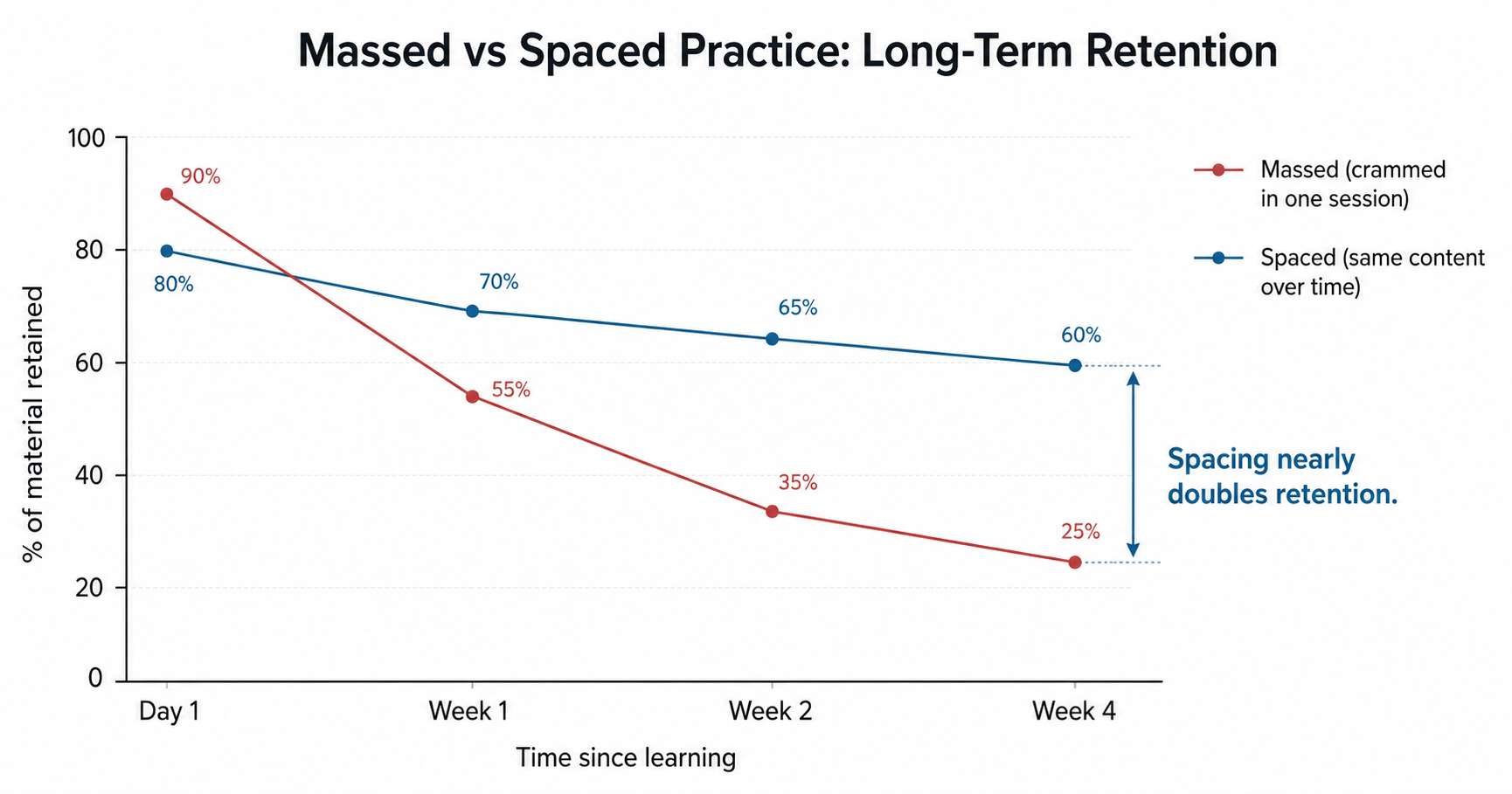
If you take the exact same training content and spread it across several shorter sessions instead of cramming it into one, employees remember dramatically more weeks and months later. Same content. Same total time. Far better retention.
This is the spacing effect, and it is one of the most reliable findings in the whole of cognitive psychology. In the largest review of the evidence, learners who spaced their study outperformed those who crammed in 259 out of 271 comparisons.
This article explains what the spacing effect is, the neuroscience behind why gaps strengthen memory, and exactly how to apply it to workplace training without adding hours to anyone's workload. It builds directly on the Ebbinghaus Forgetting Curve — if forgetting is the problem, spacing is the single best fix.
What Is the Spacing Effect?
The spacing effect is a simple idea with a powerful consequence:
Learning that is spread out over time produces stronger, longer-lasting memory than the same amount of learning packed into one session.
The key phrase is the same amount. This is not about studying more. It is about distributing the study you already do. One hour split into four 15-minute sessions across a fortnight beats one solid hour at a desk.
The effect was first documented by Hermann Ebbinghaus in the 1880s — the same researcher behind the famous Forgetting Curve. While testing his own memory, he noticed that repetitions spread over several days required far less total effort to commit material to memory than repetitions crammed into a single day.
More than a century of research has confirmed it. The most comprehensive review, a meta-analysis by Cepeda and colleagues published in Psychological Bulletin in 2006, pulled together 839 assessments from 317 experiments across 184 published articles. The verdict was overwhelming: distributing practice over time consistently beat massing it into one block.
The Neuroscience: Why Gaps Help
If repetition strengthens memory, why does spacing the repetitions out work so much better than doing them back to back? Three mechanisms are at work.
Consolidation needs time
When you learn something, the memory is initially fragile. The brain needs time — and especially sleep — to physically stabilise that memory, strengthening the connections between neurons in a process called consolidation. A gap between learning sessions gives consolidation a chance to happen. Cram everything into one sitting and you never give the first exposure time to settle before piling more on top.
Each retrieval after a gap is "effortful"
When you return to material after a delay, you have partly forgotten it. Pulling it back into mind takes effort — and that effort is exactly what strengthens the memory. Psychologists call these "desirable difficulties." A gap creates the productive struggle that locks learning in. No gap, no struggle, no strengthening.
Varied context creates more retrieval routes
Learning the same thing in different sessions, on different days, in slightly different mental states gives your brain more cues and routes back to the information later. Cramming ties the memory to one single context, which makes it harder to recall when that context is gone.
Why Cramming Feels Better But Works Worse
Here is the trap that keeps organisations cramming: massed practice feels more effective at the time.
When you study something repeatedly in one block, it feels fluent and familiar. You walk away confident you know it. This sensation is called the "fluency illusion" — and it is misleading. That confidence reflects short-term familiarity, not durable memory.
Spaced practice feels harder. Coming back to half-forgotten material is uncomfortable, and people often feel like they are learning less. But when you test both groups weeks later, the spacers win decisively. We consistently mistake the feeling of fluency for actual learning — which is why cramming remains so stubbornly popular despite a century of evidence against it.
For training managers, the lesson is uncomfortable: the format that gets the best feedback in the room (one slick, intensive session) is often the one that produces the least lasting behaviour change.
The Optimal Spacing Gap
A natural question follows: how big should the gaps be?
The research gives a clear and genuinely useful answer. The ideal gap depends on how long you need to remember the material. The longer you need the knowledge to last, the longer the gaps between sessions should be.
- If you need to remember something for a week, a gap of roughly a day or two works well.
- If you need to retain it for months or years, longer gaps — weeks apart — produce better long-term results.
This came through powerfully in the experimental work. In one study, spacing made no reliable difference when learners were tested a week later — but doubled their scores when the test came four weeks later. The benefit of spacing grows precisely when you need memory to last, which is exactly the situation most compliance and skills training is in.
The practical takeaway: short gaps for short-term recall, longer gaps for knowledge you need to stick. There is no single magic number — match the spacing to the shelf life you need.
How to Apply Spacing in Workplace Training
Spacing is one of the few learning principles that is genuinely easy to implement once you stop thinking in terms of single "events." Practical approaches:
- Break courses into a drip series. Replace the one-hour module with four 15-minute modules released over two to three weeks. Same content, spaced delivery.
- Schedule refreshers, don't rely on memory. Build automatic check-ins at increasing intervals — a week after, then a month after, then a quarter after.
- Use spaced reminders and nudges. A short prompt that re-surfaces a key point days later re-triggers the memory right as it begins to fade.
- Recertify on a rhythm, not just an anniversary. Instead of one annual data-protection blast, distribute lighter touchpoints through the year.
- Combine spacing with retrieval. Spacing works even better when each return visit asks the learner to recall something rather than just re-read it — see our guide to the testing effect.
The barrier has never been the science. It has been the admin of scheduling, releasing, and tracking content over time — which is precisely what automation removes.
Pair Spaced Training With Visual Job Aids
Formal courses handle the theory. Short, visual step-by-step Guides handle the "how do I actually do this?" moment — exactly when memory starts to fade. Record browser workflows with our free Chrome extension, or build Guides manually in TrainMeUK.
Free Guide Recorder Chrome Extension
Capture clicks and screenshots as you work — export a PDF or save to TrainMeUK
Visual Step-by-Step Guides
Short SOPs staff revisit at the point of need — checklist mode included
Free PDF Export
No TrainMeUK account required — install the extension and export locally
Built for Spaced Reinforcement
Break one long process into bite-sized Guides staff return to over time
Free to install. Record SOPs while you work — no signup required for PDF export.
Why This Matters for UK Businesses in 2026
For UK SMEs, training is rarely optional. Data protection, health and safety, cybersecurity awareness, safeguarding, anti-money-laundering — much of it is a legal or regulatory requirement, and much of it is delivered as a single annual session that the forgetting curve erases within weeks.
That creates real exposure. If an employee "completed" GDPR training in January but cannot recall a single principle by March, the completion record protects the box-tick but not the behaviour — and it is behaviour that regulators, auditors, and incident investigators ultimately care about.
Spacing changes the economics. It does not require more content or more total hours. It requires the same content delivered on a smarter schedule. For a small business without a dedicated L&D team, that is the difference between training that disappears and training that lasts.
The metric that matters is retention, not completion. Spacing is the most evidence-backed way to move that number.
Build Training That's Easy to Space and Hard to Forget
TrainMeUK courses are short and focused — typically 15–20 minutes, with larger topics broken into their core components so each module covers one area cleanly. That keeps cognitive load low and completion rates high, and it gives you the building blocks to run a spaced programme: bite-sized modules you can schedule and revisit over time rather than one overwhelming session.
Set up TrainMeUK in under a day and start delivering focused training that fits around real work.
How TrainMeUK Helps
TrainMeUK is designed around short, focused learning. Rather than long, dense sessions, courses run about 15–20 minutes, and broader subjects are reduced to their core components so each module concentrates on one area. This lowers the mental load on learners and makes content easy to complete — and because the modules are small and self-contained, they're straightforward to build into a spaced schedule, revisit, and reinforce over time.
You design focused courses; you stay in control of how and when they're delivered.
Final Takeaway
The spacing effect is one of the oldest, most replicated, and most ignored findings in learning science. Spreading the same content across several shorter sessions beats cramming it into one — not by a little, but often by double, exactly when you need the memory to last.
Cramming feels efficient. It is not. It produces a confident feeling and a fragile memory.
If your training is built around single events, you are fighting your employees' biology. Build it around spacing instead, and the same effort produces lasting knowledge.
Teach it once and it fades. Space it out and it sticks.
Learning science series
Why employees forget → Why spacing beats cramming → Why testing beats re-reading → Why overload kills learning → Why visuals beat words alone → Why tick-box training fails
Related Articles
Why Employees Forget 70% of Training in 24 Hours
The Ebbinghaus forgetting problem that spacing solves.
Read More →Why Traditional Compliance Training Doesn't Change Behaviour
UK breach data shows tick-box training doesn't reduce risk — and what does.
Read More →Why Testing Yourself Beats Re-Reading
The testing effect — the perfect partner to spacing.
Read More →Frequently Asked Questions
What is the spacing effect?
The spacing effect is the finding that learning spread out over time produces stronger, longer-lasting memory than the same amount of learning packed into a single session. First documented by Hermann Ebbinghaus in the 1880s and confirmed by over a century of research, it is one of the most reliable findings in cognitive psychology. In the largest meta-analysis (Cepeda et al., 2006, covering 839 assessments across 317 experiments), spaced practice consistently outperformed massed practice — in one analysis, in 259 out of 271 comparisons.
Why does spaced repetition work better than cramming?
Spaced repetition works better for three reasons. First, memories need time to consolidate, and gaps between sessions — especially those including sleep — give the brain time to physically stabilise what was learned. Second, returning to partly-forgotten material requires effortful recall, and that effort is what strengthens memory (a "desirable difficulty"). Third, learning across varied contexts creates more routes back to the information later. Cramming provides none of these benefits, which is why it feels effective but fades fast.
How long should the gap be between training sessions?
The optimal gap depends on how long you need to remember the material: the longer the required retention, the longer the gaps should be. For information you need for about a week, a gap of a day or two works well. For knowledge you need to retain for months or years, gaps of several weeks produce better long-term results. There is no single magic number — the gap should be matched to the "shelf life" you need from the knowledge.
Why does cramming feel more effective than it is?
Cramming creates a "fluency illusion." Studying material repeatedly in one block makes it feel familiar and easy, which we mistake for genuine learning. But that feeling reflects short-term familiarity, not durable memory. Spaced practice feels harder because you are working with partly-forgotten material — yet it produces far better long-term retention. People consistently confuse the comfortable feeling of fluency with actual learning, which is why cramming remains popular despite the evidence.
Can the spacing effect help with compliance training?
Yes — compliance training is one of the best use cases for spacing. Most compliance courses are delivered as a single annual session, which the forgetting curve erases within weeks, leaving a completion record but little retained knowledge. Because regulators and auditors ultimately care about behaviour rather than box-ticking, spacing the same content across the year (shorter touchpoints plus scheduled refreshers) produces lasting recall without adding total training hours.
Want Training That Fits Around Real Work?
TrainMeUK delivers short, focused courses — typically 15–20 minutes — with larger topics broken into their core components, so learning stays manageable and easy to complete.
Build a spaced programme without adding admin — schedule bite-sized modules and automated refreshers from one platform.