
Summary: LMS With Built-In Compliance Courses (2026)
We went looking for gaps in what UK compliance platforms cover and found none worth speaking of. High Speed Training, iHASCO, Skillcast, TrainMeUK and VinciWorks all cover the core statutory ground — data protection, fire safety, health and safety, manual handling, food hygiene, equality, harassment and safeguarding.
What separates them is how the content is priced as you add topics, how deep it goes in your sector, whether you can edit it, and whether you can prove it. Shortlist on topic coverage alone and every option looks identical.
TrainMeUK Team
UK compliance LMS specialists comparing platforms on published catalogues, pricing and audit-ready evidence — not marketing feature grids.
Every course count, price and capability below was read from vendor pages in August 2026.
Introduction
If you are searching for an LMS with compliance courses in the UK, you are probably trying to answer one question: which platforms actually come with the training, rather than expecting you to supply it?
Nearly all of them, it turns out. Established LMS platforms can now be bought with access to training content — through an included catalogue, a paid add-on or an integrated marketplace — and the UK compliance specialists cover much the same ground as each other: data protection, fire safety, health and safety, manual handling, food hygiene, allergens, equality, harassment and safeguarding. Even platforms usually written off as "no content" have libraries attached.
That is useful to know, because it means the thing most comparison guides rank on no longer separates anyone. Shortlist on topic coverage alone and every option looks identical.
Four things do separate them:
- How the content is priced. Per course per person, or included in the licence. Against the cheapest published licence, per-course buying starts costing more from around the second mandatory topic.
- How deep it goes in your sector. Everyone has "food safety". Not everyone has Level 3 for supervisors, an FCA library, or SRA modules for law firms.
- Whether you can change it. UK regulators require training appropriate to the role and the risk. Only two of the five vendors here let you edit their courses yourself.
- Whether you can prove it. Every system logs completions. Far fewer produce the evidence pack an inspector asks for, covering a period that includes people who have since left.
Written for the buyer this search usually represents: an operations manager, HR lead or office manager at a UK business of 20–500 people, with no training administrator and a legal duty to evidence that staff have been trained.
How This Comparison Was Built
Every course count, price, accreditation and capability was read from the vendor's own published pages, price lists and catalogues in August 2026. Legal requirements are cited to primary legislation or to the relevant regulator, not to secondary summaries.
Figures only the vendor asserts are labelled vendor-stated. Where a vendor's own numbers disagree with each other, we say so rather than picking the flattering one — two of them do below.
We do not mark a vendor down for something we simply couldn't find. Where a capability could not be established either way, the table says "Ask". A dash requires evidence of absence, not absence of evidence. Corrections welcome — hello@trainmeuk.co.uk. Last reviewed: August 2026.
Three ways the same thing is sold
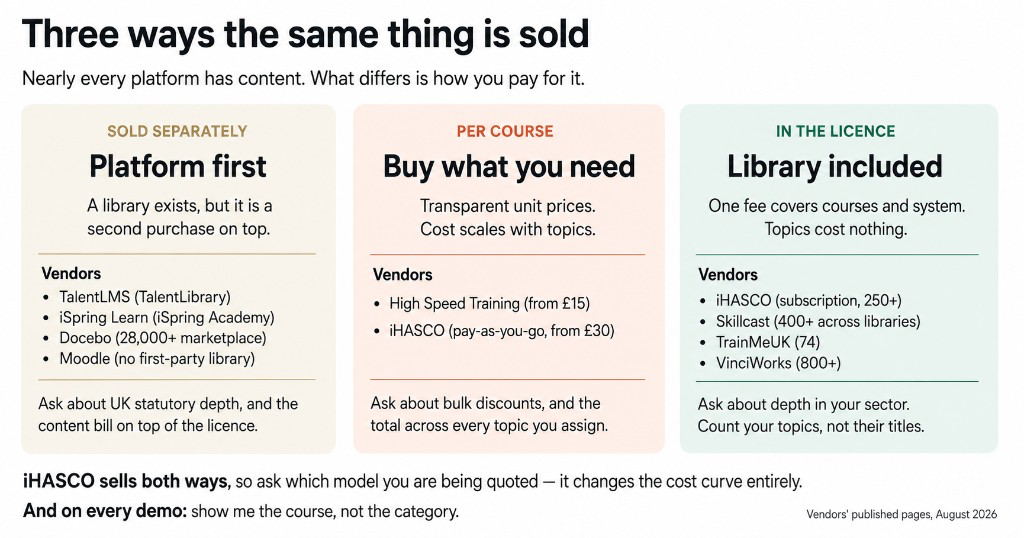
Delivery platforms, content sold separately. Moodle, TalentLMS, iSpring Learn and Docebo host, assign, track and report. Most have a library attached — TalentLMS has TalentLibrary, iSpring integrates Udemy, Go1 and LinkedIn Learning, Docebo's marketplace carries tens of thousands of courses. Moodle is the genuine exception. The catch isn't availability, it's that the library is a separate purchase on top of the platform licence and its UK statutory depth is generally thinner, because it serves a global customer base.
Content priced per course. High Speed Training is the clearest example: a fully published price list from £15 to £150, and a Management Suite included free with team purchases that handles bulk upload, allocation, progress tracking, custom reports and renewals. iHASCO offers pay-as-you-go alongside its subscription.
Content included in the licence. A per-user or flat fee covers library and system together, so adding topics costs nothing. Skillcast, TrainMeUK and VinciWorks work this way, as does iHASCO's subscription tier.
A vendor can sit in more than one group — iHASCO is the clearest case — so "which model am I being quoted?" is a real question. It changes the cost curve completely.
Don't assume a content-first vendor has a weak platform. iHASCO's Atlas offers SSO with Azure, Okta and OneLogin, a client API, smart enrolment by job role, granular admin permissions and exportable audit-ready reporting. That is a capable LMS by any measure.
For the platform-side comparison — ease of use, Microsoft 365 integration, automation, admin overhead — see our guide to the best LMS for small UK businesses. For the broader market primer — what an LMS is, UK pricing, and how to shortlist — see learning management systems in the UK (2026). This page stays on content.
The demand to make on every demo: show me the course, not the category. A tile labelled "Data Protection" tells you nothing. Open it and check whether it reflects UK GDPR as amended by the Data (Use and Access) Act 2025, or a generic European framework.
What UK law actually requires
UK legislation almost always requires adequate training appropriate to the role, and requires you to demonstrate it. It rarely names a course or certificate. Vendors sometimes imply their certificate is the legal requirement. It isn't — the record of appropriate training is.
Data protection. No UK GDPR article tells every employer to run a named staff course. The expectation arises from Article 5(2), which requires you to demonstrate compliance, and Article 32, which requires appropriate organisational measures — and, where an organisation has appointed a DPO, from Article 39, which assigns staff awareness-raising and training to that role. Not every organisation must appoint a DPO, so Article 39 explains the expectation where one exists rather than creating a universal mandate. Worth correcting a common claim: the ICO does not mandate annual refresher training. Its accountability framework asks you to set a specified timeframe, assign someone to confirm completion within it, and provide additional training for higher-risk roles. Annual is convention, not rule — what the ICO checks is whether you defined an interval and then met it. Full guide: Is GDPR training a legal requirement in the UK?
Fire safety. Article 21 of the Fire Safety Order 2005 requires adequate training when first employed, on exposure to new or increased risks, and periodically. It must take place during working hours and match the risks in your fire risk assessment.
General health and safety. Section 2(2)(c) of the Health and Safety at Work etc. Act 1974 requires "such information, instruction, training and supervision as is necessary". Regulation 13 of the Management of Health and Safety at Work Regulations 1999 sets the timing — on recruitment and on exposure to new risks — and requires employers to take account of employees' capabilities. Breach is a criminal offence.
Manual handling. The Manual Handling Operations Regulations 1992 require employers to avoid hazardous handling so far as reasonably practicable, assess what cannot be avoided, and reduce the risk, with training under regulation 4(1)(b)(iii). The HSE is explicit that training does not substitute for avoiding or reducing the handling operation. An e-learning module alone does not discharge the duty.
Food hygiene. Assimilated Regulation (EC) 852/2004, Annex II, Chapter XII requires food handlers to be "supervised and instructed and/or trained in food hygiene matters commensurate with their work activity". There is no legal requirement to hold a Level 2 certificate — Level 2 is industry convention. What Environmental Health Officers ask for is evidence. Full guide: Food safety training requirements for UK businesses
Harassment and equality. The Worker Protection (Amendment of Equality Act 2010) Act 2023 took effect on 26 October 2024: employers must take reasonable steps to prevent sexual harassment, including by third parties. A tribunal can uplift compensation by up to 25% where the duty was unmet, and the EHRC can enforce without any incident having occurred. Training isn't the whole answer — the EHRC expects risk assessment and policy alongside it — but a current, documented course is one of the more visible reasonable steps available.
What's actually in each library
"Yes" means dedicated course content found in the vendor's published catalogue in August 2026.
| Topic | High Speed Training | TrainMeUK | iHASCO | Skillcast | VinciWorks |
|---|---|---|---|---|---|
| Library size | 180+ | 70+ | 222 | 400+ | 800+ |
| UK GDPR / data protection | Yes | Yes | Yes | Yes | Yes |
| Fire safety | Yes | Yes | Yes | Yes | Yes |
| General health & safety | Yes | Yes | Yes | Yes | Yes |
| Manual handling | Yes | Yes | Yes | Yes | Yes |
| Food hygiene | L1–L3 | L1–L2 | L1–L3 | Ask | L1–L3 |
| Allergens | Yes | Yes | Yes | Yes | Yes |
| Equality & diversity | Yes | Yes | Yes | Yes | Yes |
| Sexual harassment | Yes | Yes | Yes | Yes | Yes |
| Safeguarding | Yes | Yes | Yes | Yes | Yes |
| AML / financial crime | Yes | Yes | Yes | Yes | Yes |
| FCA / SMCR | — | — | — | Yes | Yes |
| SRA (law firms) | — | — | — | Yes | Yes |
| SSO | Ask | Yes | Yes | Ask | Yes |
| Office 365 integration | Ask | Yes | Yes | Ask | Yes |
| Auto-assign by role/dept | Ask | Yes | Yes | Yes | Yes |
| Import your own SCORM | Ask | Yes | Ask | Ask | Premier only |
| Edit the vendor's courses | Ask | Yes | No | Bespoke | Yes |
| Published pricing | Yes | Yes | Partial | Partial | No |
"Ask" means we could not establish it either way — put it on your demo list. A dash means no dedicated course was found in the published catalogue at the time of writing; it is not a confirmed absence.
Course counts are the least reliable number on any vendor site. High Speed Training's own site gives three figures on a single page: "over 160" in the title, "over 180" in the course navigation, "over 170" in the FAQ. iHASCO's pricing page says 250+, its accreditation page says 200+, and its published course list contains 222 distinct titles. Get the number that matters — your six to twelve mandatory topics — in writing.
Three things worth pulling out of the table.
Sector shapes the answer far more than size does. FCA-regulated? Skillcast's 60+ module FCA library and full SMCR set have no equivalent here. Hospitality or food manufacturing? High Speed Training's food safety depth and accreditation stack matter more than any total. Law firm? Skillcast and VinciWorks are the only serious options.
Recency separates the field more than breadth does. The Data (Use and Access) Act 2025 received Royal Assent on 19 June 2025, and its main data protection provisions commenced on 5 February 2026 — changing automated decision-making, introducing recognised legitimate interests and altering subject access timings. A data protection course that doesn't reflect those changes isn't current. Ask any shortlisted vendor how they handled it; the answer tells you more than a course count.
"Can I upload my own content?" is a tier question, not a yes/no. VinciWorks splits it explicitly: Astute Essentials deploys VinciWorks courses only, Astute Premier adds your own e-learning, policies, quizzes and instructor-led training. Ask on which plan.
One market note: EssentialSkillz and its WorkWize LMS, still listed as standalone by many comparison sites, have been absorbed into VinciWorks. A guide still recommending WorkWize hasn't been re-checked in some time.
Best Fit, in One Line Each
High Speed Training
Hospitality, catering and food manufacturing, or anyone wanting transparent per-course prices and the deepest accreditation stack. Management Suite included free, but no SSO or HR integration.
iHASCO
The broadest general-purpose UK compliance catalogue, visibly maintained, paired with a genuinely capable LMS.
Skillcast
FCA-regulated firms, insurers and law firms. FCA, SMCR and SRA depth unmatched here, and CoreCompliance publishes a price at the small-business end.
TrainMeUK
Organisations with no training administrator needing library, renewals and audit evidence on one licence, with cost flat as topics are added. Food safety stops at Level 2.
VinciWorks
Multi-jurisdiction groups and law firms wanting the widest catalogue plus in-browser editing of vendor courses.
Can you edit the courses?
Read those statutory duties again and notice what they share. Food handlers must be trained "commensurate with their work activity". Fire training must be appropriate to the risks in your assessment. The 1974 Act requires training "as is necessary". Regulation 13 requires you to account for employees' capabilities. The ICO expects role-based training; the EHRC expects harassment prevention grounded in your own risk assessment.
None of that says "a generic awareness course". To be clear: no UK regulator requires you to customise e-learning, and for common risks in a conventional workplace a well-made off-the-shelf course is perfectly capable of being adequate. Generic is not the same as non-compliant. But where your risks are unusual, your equipment specific, or your procedures different from the norm, a stock module is the starting point rather than the finished article — and at that point editability stops being a convenience and becomes how you evidence "appropriate to the role".
- VinciWorks has the strongest story: in-browser editing of text, branding and design, duplicating a course for department-specific versions that still inherit updates, and review workflows before publishing.
- TrainMeUK opens 70+ built-in courses in its course builder, on Growth plans and above. Entry-tier customers get the library as supplied.
- iHASCO is explicit that you cannot: text on the completion screen and certificate only, with deeper changes through a paid bespoke service. Its AI Course Creator authors alongside the catalogue rather than editing it.
- Skillcast offers bespoke development as a service, not self-serve editing.
- High Speed Training publishes no course-editing capability.
Take this into every demo: "Can I edit your course to reflect our procedures — myself, on my plan, without paying for a bespoke project?" Two of the five answer no or bespoke; a third doesn't publish a position.
If it's AI-assisted, what stops it inventing the law?
Compliance risk: a language model asked to write about fire safety law will happily produce a plausible regulation number that does not exist. A fabricated statute in your training is worse than no training, because you have now documented telling staff something untrue.
Most vendors here now offer some AI authoring. So ask what constrains it. Is generation restricted to sources you supply or an allowlist of regulator domains? Are factual claims tied to a specific passage in a source? Can the system refuse to publish when a claim can't be evidenced? Skillcast's Aida assistant answers regulatory questions with cited sources. TrainMeUK's pipeline works from uploaded documents or an allowlist, binds claims to evidence, and can block publication where a claim fails its checks — with AI course generation capped by plan at 10, 20 or 50 a month. Interrogate any vendor's AI on this, ours included: ask what happens when you request a course about a regulation that doesn't exist.
Whichever vendor you choose, a human should review AI-drafted compliance content before it reaches a learner. Grounding reduces the risk of an invented statute; it does not transfer responsibility for what your training tells staff.
What a six-topic programme costs
Headline per-seat prices mislead, because compliance buyers don't buy one course. The useful question: what does it cost to put data protection, fire safety, general H&S, manual handling, food hygiene and harassment in front of fifty employees, and keep it current? All figures exclude VAT.
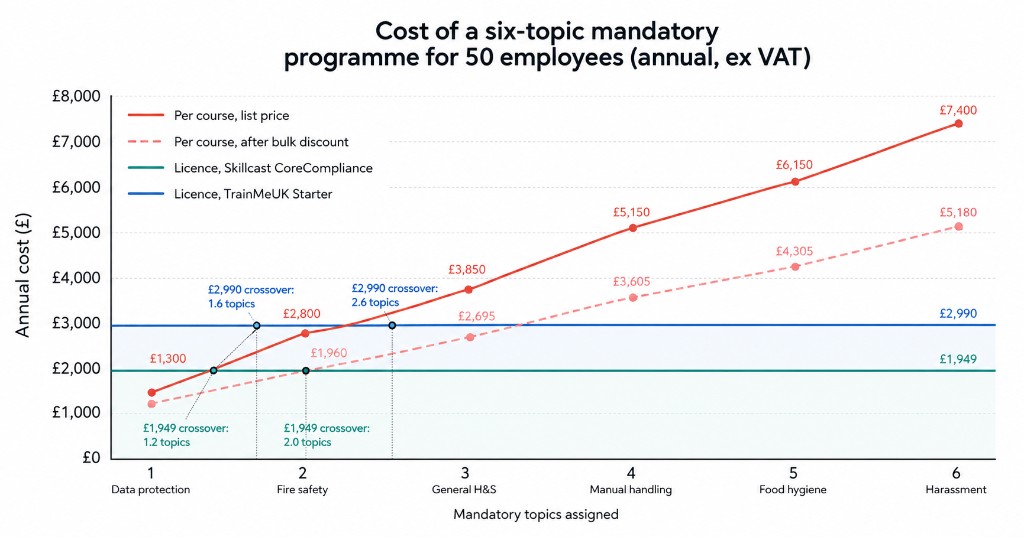
Per-course pricing scales with topics × people. From High Speed Training's published list: Data Protection & UK GDPR £26, Fire Safety Awareness £30, Basic Health and Safety £21, Manual Handling Awareness £26, Level 2 Food Hygiene for Catering £20, Sexual Harassment for Employees £25 — £148 per person, or £7,400 across fifty staff at list price.
Bulk discounts reduce that, but read the bands. They start at 10% for ten or more courses and apply across mixed baskets, so a six-topic order for fifty people counts as a single order of 300 course licences rather than six orders of fifty. The headline "up to 40%" applies at 500 or more courses, which also comes with a dedicated account manager — so a 300-unit order sits a band lower, at roughly £5,180. The bands sit in an image on their team-training page rather than in text, so get a quote rather than trusting anyone's arithmetic including ours.
Licence pricing scales with people only. Skillcast CoreCompliance publishes £1,949 a year for 41–50 users covering 150+ courses with unlimited usage — the cheapest published licence in this comparison, capped at 50 users and split into Financial Services and General plans. TrainMeUK Starter is £249 a month billed annually for up to 50 users — a published £2,990 a year — moving to £55 per user for 51–250, £50 for 251–999, and quoted above that. iHASCO publishes no 50-seat figure; its calculator returns £5.85–£7.30 per learner per month at its default of 30 learners, roughly £2,110–£2,630 a year at that size. VinciWorks publishes nothing.
Where the lines cross. Averaged across the basket, each additional topic costs about £1,230 a year for fifty people at list price, or about £860 after the 300-unit discount band. Against Skillcast at £1,949, per-course buying costs more from roughly the second topic at list, or the third once discounted. Against TrainMeUK Starter at £2,990, the crossover sits between the third and fourth. Either way it arrives earlier than most buyers expect — which makes the right question not "what does a seat cost?" but "how many topics will I be assigning in three years?"
Two costs are almost always left out. Administration: if a platform can't assign by department, job title or location automatically, someone re-does it by hand every time you hire. And content maintenance: if you author compliance courses yourself, someone owns updating them when the law changes.
Audit-readiness
Every LMS logs completions. That is not the same as surviving an inspection.
An Environmental Health Officer, HSE inspector or ICO caseworker is in reception. Show me, in under two minutes, the report proving every food handler across three sites completed Level 2 within our renewal cycle — including the two who left last month.
Weak systems export a raw CSV you then interpret. Strong systems produce a formatted evidence pack. Check for:
- Reporting by group, site and department, not just a per-course completion percentage.
- Retrievable certificates, plus a central register of who trained, when, and on which version.
- Expiry and renewal tracking showing what is due, not only what is done. Spreadsheet compliance fails here first.
- Records for leavers. Auditors ask about the period, not the current headcount.
- A protected audit log of administrative changes, particularly where completion records can be amended by hand.
- Framework mapping — filtering by regime turns "40 completions" into "our coverage against this framework".
More detail: How fast you should produce training records for an auditor.
Five Questions for Every Demo
-
1.
"Which of my mandatory topics are in your library today, and when was each last reviewed?" Name your actual topics. Review date, not publication date.
-
2.
"Is the library included in the licence, or priced separately?" Then: does the price move when I add topics, or only people?
-
3.
"Can I edit your courses and upload my own content — on which plan, and at what extra cost?" All three qualifiers matter.
-
4.
"Show me the audit report." Live, filtered to one department.
-
5.
"How does a renewal actually happen?" Does the platform reassign on expiry, or email someone who then has to remember?
If a vendor can't answer question one precisely, the rest of the evaluation is premature.
Where TrainMeUK fits
Built for the buyer this guide describes: a UK organisation with real compliance obligations and no full-time training administrator.
The library is included, not a bolt-on. Every plan ships 70+ UK-specific courses — GDPR, fire safety, COSHH, manual handling, DSE, food safety Levels 1–2 with six allergen modules, equality and diversity, sexual harassment, safeguarding, first aid and cyber security — with unlimited assignments. TrainMeUK is a CPD accredited provider.
Renewals are driven by the system, not by memory. Courses carry validity windows; when a completion expires the platform reassigns it and chases by email or Microsoft Teams. Expiry reports show what is coming due.
The catalogue is editable. On Growth and above, 70+ built-in courses open in the course builder, so a manual handling module can carry your own lifting procedures. Courses export as SCORM 1.2 or 2004, so nothing is locked in. VinciWorks matches the editing capability and arguably exceeds it on workflow; the difference is that ours sits inside a published SME price rather than an enterprise quote.
Evidence is a first-class output. Courses map to 25+ UK regulatory frameworks including HSE, ICO, FSA, Ofsted and KCSIE. Report packs cover department coverage, user register, at-risk learners and upcoming renewals, with an audit log of administrative actions. External certificates such as CSCS can be uploaded, expiry-tracked and approved alongside e-learning.
Where we are not the right answer
- • Skillcast for FCA or SMCR depth — and at £1,949 for up to 50 users it undercuts our Starter plan if finance content is what you need
- • Skillcast or VinciWorks for SRA-specific law firm training
- • High Speed Training, iHASCO or VinciWorks if you need food safety above Level 2
- • The bigger content houses if soft-skills breadth matters more than regulatory depth
See the catalogue before you commit
Browse the full 70+ course UK compliance library, assign it to a test group and pull an audit report — inside a 14-day free trial, no credit card.
Final Verdict
There is no single best LMS with built-in compliance courses, because compliance means something different in a restaurant group, a housing association and an investment firm.
But the research changed how we'd tell you to shortlist. Topic coverage isn't the deciding factor — the established UK vendors all cover the core statutory ground, and a comparison built on ticks and crosses tells you almost nothing. Four questions will:
-
1.
How does the price move when I add a seventh topic? The models diverge from around the second or third.
-
2.
How deep does it go in my sector? Level 3 food safety, FCA and SMCR, SRA, construction — the real gaps are here, not in the headline topics.
-
3.
Can I edit the course myself, on my plan? Two of the five say yes.
-
4.
Can it produce the evidence pack, including leavers, in under two minutes?
Answer those in order and the shortlist usually picks itself.
Nearly everyone has the courses now. Almost nobody will tell you what happens when you need to change them, prove them, or add ten more.
Related Resources
Is GDPR Training a Legal Requirement in the UK?
What the ICO expects, who must be trained, how to evidence it.
Read Guide →Food Safety Training Requirements for UK Businesses
Levels 1–3, what EHOs check, proving compliance without spreadsheets.
Read Guide →Best LMS for Small UK Businesses
The platform-side comparison covering ease of use, Microsoft 365, automation and pricing.
Read Guide →Best LMS Platforms Compared (2026)
Docebo, LearnUpon, TalentLMS, iSpring and TrainMeUK — pricing, features and fit.
Read Guide →How Fast Should You Produce Training Records?
What auditors expect when they ask for evidence under pressure.
Read Guide →Mandatory Training Requirements UK
What UK businesses must train staff on in 2025–2026, by topic and sector.
Read Guide →Frequently Asked Questions: LMS With Compliance Courses
Common questions about choosing an LMS with built-in UK compliance courses. Click on any question to expand the answer.
Which LMS platforms include UK compliance courses as standard?
Several UK vendors include content in the licence rather than selling it separately. TrainMeUK ships 70+ UK compliance courses on every plan; Skillcast and VinciWorks combine substantial libraries with their own platforms, Skillcast strongest on FCA and financial services, VinciWorks broadest overall. iHASCO and High Speed Training are content-first providers with deep UK catalogues, typically priced per course or per learner. Moodle, Docebo and iSpring Learn are delivery systems where compliance content is bought or built separately, though TalentLMS's TalentLibrary includes a UK compliance collection as a paid add-on. EssentialSkillz and WorkWize, still listed by many comparison sites, have been absorbed into VinciWorks.
Is it cheaper to buy per course or as part of an LMS licence?
It depends almost entirely on how many topics you assign. Per-course is cheaper for a narrow programme, and High Speed Training's published prices of roughly £20–£35 for common awareness courses make it easy to budget. Bulk discounts start at 10% for ten or more courses and apply across mixed baskets, with the top 40% band reserved for orders of 500 or more. But cost still scales with topics multiplied by people: a six-topic basket is £148 per person, £7,400 across fifty staff at list, around £5,180 at the band a 300-course order reaches. A licence including the library scales with headcount only. Against the cheapest published licence — Skillcast at £1,949 for 41–50 users — the crossover lands between the second and third topic; against TrainMeUK Starter at £2,990, between the third and fourth.
Is online compliance training legally valid in the UK?
Yes. UK legislation almost never specifies a delivery method — it requires training that is adequate, appropriate to the role, and demonstrable. Section 2(2)(c) of the 1974 Act requires "information, instruction, training and supervision"; Article 21 of the Fire Safety Order requires adequate fire safety training; assimilated Regulation (EC) 852/2004 requires food handlers to be trained commensurate with their work. E-learning satisfies these where content matches the risk and records are kept. The exception is manual handling, where the HSE is clear that training does not replace the duty to avoid or reduce the handling operation.
How often does compliance training need to be refreshed?
It depends on the regime, and most say "periodically" rather than naming an interval. Contrary to what many providers imply, the ICO does not mandate annual data protection refreshers — its accountability framework asks you to set a timeframe, assign responsibility for confirming completion, and give higher-risk roles additional training. Fire safety training must be repeated periodically and whenever risks change. Food hygiene has no statutory expiry, though three years is the widely used industry convention. The practical upshot is the same: define a renewal cycle per topic, document it, and let the system enforce it. Inspectors ask what your policy is, then check whether you followed it.
If your priority is an included UK compliance library, automated renewals and audit-ready evidence at a published price, TrainMeUK is worth exploring alongside the specialists in this guide.
Ready to Compare Against Your Mandatory Topics?
Bring your six to twelve required courses to a demo. We'll show what's in the library, how renewals work, and what an audit report looks like for your structure.