
Introduction
Most people in construction can name CDM 2015. Fewer can say precisely who holds which duty, when a project becomes notifiable, or what evidence they'd need to produce if the HSE turned up tomorrow.
That gap matters because failing to comply with CDM 2015 is a criminal offence — the HSE can issue improvement and prohibition notices and prosecute duty holders, with penalties including heavy fines and custodial sentences. It's not guidance you can treat loosely; it's law with teeth, and enforcement increasingly turns on whether you can prove competence and control, not just assert them.
This guide sets out CDM 2015 for principal contractors: the roles, the thresholds, the documents, and — the part that ties it all together — competence evidence. For the record-keeping that underpins compliance, see our guide on the construction training matrix. If you need to hold that evidence against the people actually on site, see our construction training software.
What CDM 2015 Is and Why It Exists
The Construction (Design and Management) Regulations 2015 are the main health and safety regulations governing UK construction, enforced by the HSE. They exist on a simple premise: many construction deaths and injuries are preventable if health and safety is considered from the earliest stages of design and planning, rather than left to chance on site.
CDM 2015 replaced the 2007 regulations, most notably swapping the old CDM coordinator role for the principal designer, and extending duties to domestic clients. It applies to all construction work in the UK — domestic or commercial, regardless of size or duration. The core aim is that risks are managed systematically, competent people are appointed in good time, everyone has the information and training they need, and duty holders cooperate and coordinate.
The Duty Holders and Who Does What
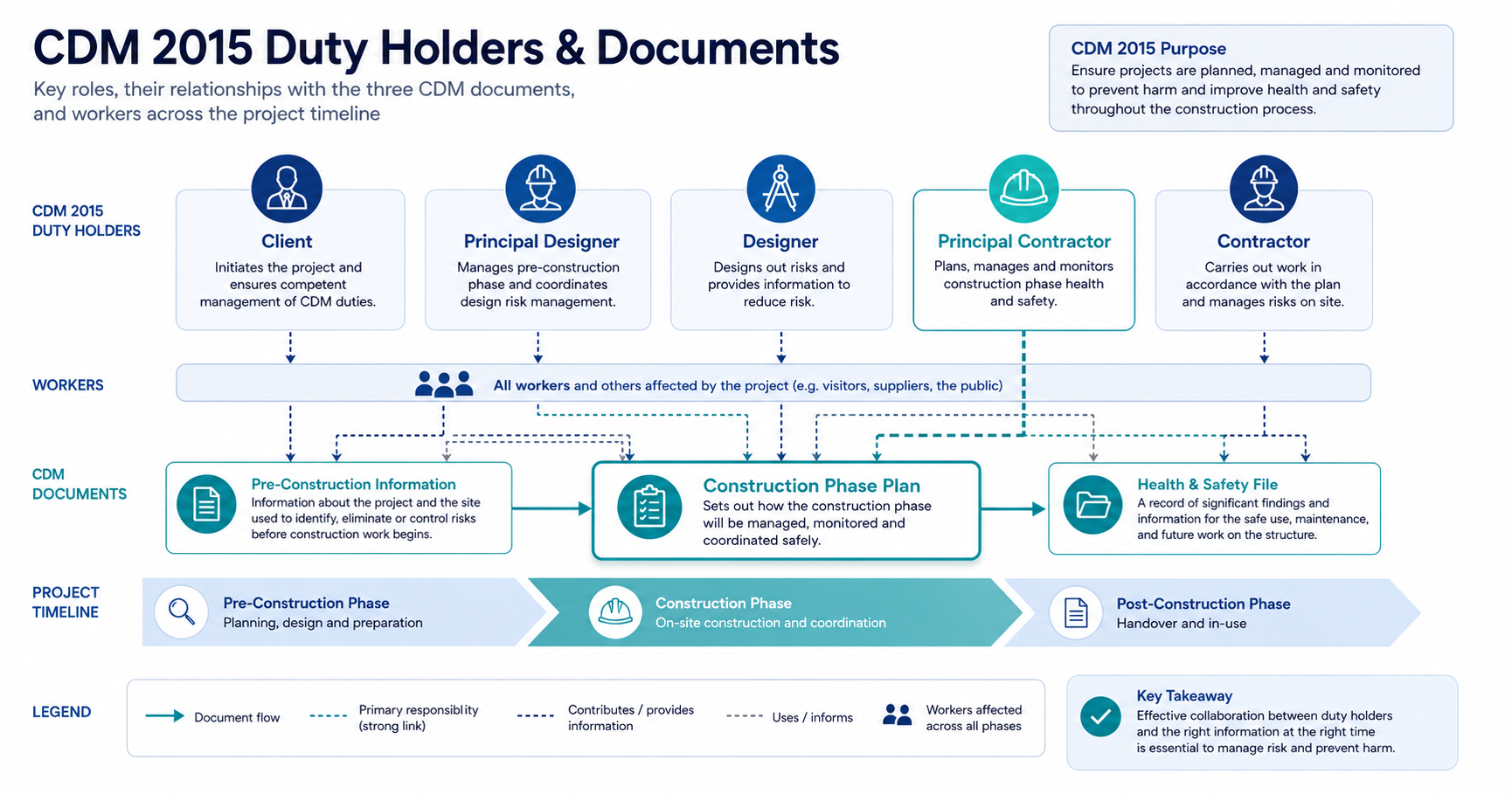
CDM 2015 defines five appointed duty-holder roles, with workers carrying their own duties on top:
- Client — any individual or organisation commissioning construction work. Commercial clients must make suitable arrangements for managing the project, appoint competent duty holders, and ensure the required documents exist. (Domestic clients' duties normally pass to the contractor or principal contractor.)
- Principal designer — plans, manages, monitors, and coordinates health and safety during the pre-construction phase; compiles pre-construction information and the health and safety file. Required on projects with more than one contractor.
- Designer — anyone who prepares or modifies a design (architects, engineers, surveyors, and others); must eliminate or reduce design risks.
- Principal contractor — plans, manages, monitors, and coordinates health and safety during the construction phase. Required on projects with more than one contractor.
- Contractor — anyone carrying out construction work, including subcontractors of any tier; must plan and manage their own work and only engage people with the necessary competence.
Workers also have duties: to work only within their competence (or with the training and supervision to do so safely), to be aware of the site's risks, to cooperate with duty holders, and to report anything unsafe.
When a Project Must Be Notified (the F10)
A project is notifiable — meaning the HSE must be told before the construction phase begins — if the construction work is expected to:
- last longer than 30 working days AND have more than 20 workers working simultaneously at any point, or
- exceed 500 person-days (people multiplied by days).
Notification is made via the online F10 form. Crucially, this is the client's duty — though in practice the principal designer or principal contractor often submits it on the client's behalf, the client remains legally responsible for its accuracy. Every duty holder shares a duty to ensure the client knows their responsibilities, so "the client forgot" isn't a clean defence for anyone.
Two things principal contractors should note: the F10 must be displayed on site (typically on the site notice board) in a form workers can read, and CDM duties apply whether or not a project is notifiable — notification is an added step for larger projects, not the trigger for the duties themselves. On a non-notifiable job you still plan, manage, and monitor the work properly.
The Three Documents CDM Requires
CDM compliance produces a clear document trail:
- Pre-Construction Information (PCI) — provided by the client (assembled with the principal designer) to designers and contractors tendering for the work, so they can plan safely.
- Construction Phase Plan (CPP) — prepared by the principal contractor before the construction phase begins, setting out how health and safety will be managed on site. On single-contractor projects the contractor prepares it.
- Health and Safety File — compiled by the principal designer, updated by the principal contractor through the build, and handed to the client at completion. It records information needed for future maintenance, alteration, or demolition.
Alongside these, induction records, risk assessments, and method statements form the practical evidence that the plan was actually followed — and these are routinely requested by HSE inspectors and by clients during procurement.
The Principal Contractor's Core Duties
During the construction phase, the principal contractor must:
- Plan, manage, monitor, and coordinate health and safety across the whole construction phase.
- Prepare and maintain the Construction Phase Plan and amend it as the project changes.
- Ensure every worker receives a suitable, site-specific induction — covering all workers on site, not just their own.
- Secure the site against unauthorised access and provide adequate welfare facilities.
- Prepare and enforce site rules and ensure cooperation and coordination between contractors.
- Only engage contractors and workers with the necessary skills, knowledge, training, and experience (or who are obtaining them), and establish whether further training is needed.
- Consult and engage workers on health and safety, and liaise with the principal designer, updating the health and safety file.
The principal contractor is also a contractor, so all the contractor duties apply on top.
Competence: The Thread Running Through Everything
Strip CDM 2015 back and one idea runs through every role: competence. Clients must appoint competent duty holders. Contractors must only engage people with the necessary skills, knowledge, training, and experience. The principal contractor must establish whether training is needed and ensure workers are competent for their tasks. And the assessment isn't one-off — training needs should be reviewed throughout a project, because risks change as work changes and skills decline if unused.
This is where CDM meets the practical reality of the site: CSCS cards, SMSTS and SSSTS certificates, task-specific tickets, and inductions are how competence is evidenced day to day. And increasingly, clients are scrutinising principal contractors for that evidence — because the client carries ongoing responsibility for ensuring suitable arrangements are in place, they push the demand for proof down the chain. "Everyone was competent" is not enough; you need to be able to show how you knew. For role-by-role training expectations, see CDM training and competence by role.
Why This Matters for UK Construction in 2026
Enforcement is real and it's costed. Beyond improvement notices, prohibition notices (which can stop work immediately), and prosecution, the HSE's Fee for Intervention recovers its costs from duty holders found in material breach — currently £163 per hour. CDM documentation is routinely requested both by inspectors and by clients during procurement, so the evidence isn't just for emergencies; it's a condition of winning and keeping work.
The Building Safety Act has raised the bar further, reinforcing that contractors are responsible for ensuring everyone on site is trained and qualified. The consistent direction of travel is toward demonstrable, current competence evidence — which is exactly the discipline that CDM has required all along, now enforced more sharply. For how that evidence is tested, see our guide on construction audit and PQQ training evidence.
Turn CDM Competence Duties into Provable Records
TrainMeUK holds training, certificates, inductions, and external qualifications like CSCS cards in one place — with expiry tracking and audit-ready reporting, so competence evidence is ready when the HSE or a client asks.
How TrainMeUK Helps
CDM 2015 is a documentation and competence regime, and that's precisely where TrainMeUK fits. The platform records the training you deliver, tracks external qualifications and certificates — CSCS cards, SMSTS/SSSTS, task tickets — against their expiry dates, and captures site inductions per person, so the competence evidence CDM requires exists in one place rather than scattered across files.
Its reporting produces audit-ready output showing who is in scope, who is compliant, and where the gaps are — the kind of evidence pack an HSE inspector or a client's procurement team asks for. Courses can be mapped to relevant regulatory frameworks so you can report against them directly. For firms using Site Management, competence requirements can be tied to site access, so an unqualified or un-inducted worker is flagged at the gate. TrainMeUK doesn't replace your CDM duties or the professional judgement behind a Construction Phase Plan — it makes the competence and training evidence behind those duties current, provable, and quick to produce.
Final Takeaway
CDM 2015 asks one question in a hundred forms: can you prove the right, competent people were appointed, informed, and managed? Answer that with evidence rather than assurance, and compliance stops being a scramble and becomes a record you can hand over on demand.
Related Articles
How to Build a Construction Training Matrix
The record structure behind CDM competence.
Read More →SMSTS & SSSTS Renewals
Keeping management competence current.
Read More →Construction Audit & PQQ Training Evidence
Proving competence to clients and the HSE.
Read More →Frequently Asked Questions
Who are the duty holders under CDM 2015?
CDM 2015 defines five appointed duty-holder roles: the client (who commissions the work), the principal designer (who coordinates health and safety in the pre-construction phase), designers (who prepare or modify designs), the principal contractor (who coordinates health and safety during construction), and contractors (who carry out the work). Workers also have their own duties, including working only within their competence and reporting anything unsafe. The principal designer and principal contractor roles are required on any project with more than one contractor.
When does a construction project need to be notified to the HSE?
A project is notifiable if the construction work is expected to last longer than 30 working days with more than 20 workers on site simultaneously at any point, or to exceed 500 person-days of work. Notification is made via the online F10 form before the construction phase begins, and it's the client's legal duty — even though the principal designer or principal contractor often submits it on the client's behalf. Importantly, CDM duties apply whether or not a project is notifiable; notification is simply an additional requirement for larger projects.
What documents does CDM 2015 require?
The three core documents are the Pre-Construction Information (provided by the client to those tendering), the Construction Phase Plan (prepared by the principal contractor before construction begins), and the Health and Safety File (compiled by the principal designer, updated by the principal contractor, and handed to the client at completion). Alongside these, induction records, risk assessments, and method statements provide the practical evidence that the work was planned and managed safely, and all of these are routinely requested by HSE inspectors and by clients during procurement.
What are the penalties for breaching CDM 2015?
Failing to comply with CDM 2015 is a criminal offence. The HSE can issue improvement notices, prohibition notices that stop work immediately, and can prosecute duty holders — including clients, principal designers, and principal contractors — with penalties including heavy fines and, in serious cases, custodial sentences. The HSE also operates Fee for Intervention, recovering its costs from duty holders found in material breach of health and safety law at a rate of £163 per hour, so even non-prosecution enforcement carries a direct cost.
How does a principal contractor demonstrate worker competence under CDM 2015?
Competence is demonstrated through evidence that the right people were engaged and are qualified for their roles — in practice, CSCS cards, SMSTS and SSSTS certificates, task-specific tickets, and completed site inductions, all current and verifiable. CDM requires the principal contractor to only engage people with the necessary skills, knowledge, training, and experience, and to review training needs throughout the project as risks and tasks change. Because clients increasingly ask principal contractors to prove this competence during procurement and audits, keeping the evidence current and quick to produce has become a practical necessity, not just a legal one.
Keep Your CDM Competence Evidence Audit-Ready
See how TrainMeUK tracks training, certificates, and inductions in one place, with reporting built for the moment an inspector or client asks.
Sources: CDM Regulations 2015; HSE — CDM 2015; Building Safety Act 2022.