
Introduction
Most site managers know their SMSTS certificate lasts five years. Far fewer track the date closely — until they discover, too late, what happens when it lapses.
Let an SMSTS or SSSTS certificate expire and you generally lose access to the short refresher entirely — you have to sit the full course again, at higher cost, more time away from work, and a period where you can't legally fulfil your role on major sites. The refresher exists to make renewal cheap and quick. Missing the window turns a two-day update into a five-day retake, or a one-day update into a two-day one.
The certificates themselves are straightforward. It's the renewal timing that catches people out, and the cost of getting it wrong is disproportionate. This guide covers the intervals, the rules, and how to stop them slipping. For tracking these alongside CSCS and other tickets, see our guide on the construction training matrix. Teams running this across sites usually keep the dates in construction training software rather than a separate spreadsheet.
What SMSTS and SSSTS Certificates Cover
Both are part of the CITB Site Safety Plus scheme:
- SMSTS (Site Management Safety Training Scheme) is the five-day course for site managers, project managers, and contracts managers. It covers planning, organising, monitoring, and administering health and safety across a whole project.
- SSSTS (Site Supervisors Safety Training Scheme) is the two-day course for supervisors, covering how supervisors influence standards, behaviours, and safe working on site.
Neither is a legal requirement in the strict sense, but both are contractually required on virtually every significant UK construction project. Under CDM 2015, duty holders must demonstrate competence, and continuous SMSTS/SSSTS certification is a common way of evidencing it — which is why principal contractors and clients routinely verify them before appointment. For how that maps by role, see CDM training and competence by role.
The Five-Year Validity Rule
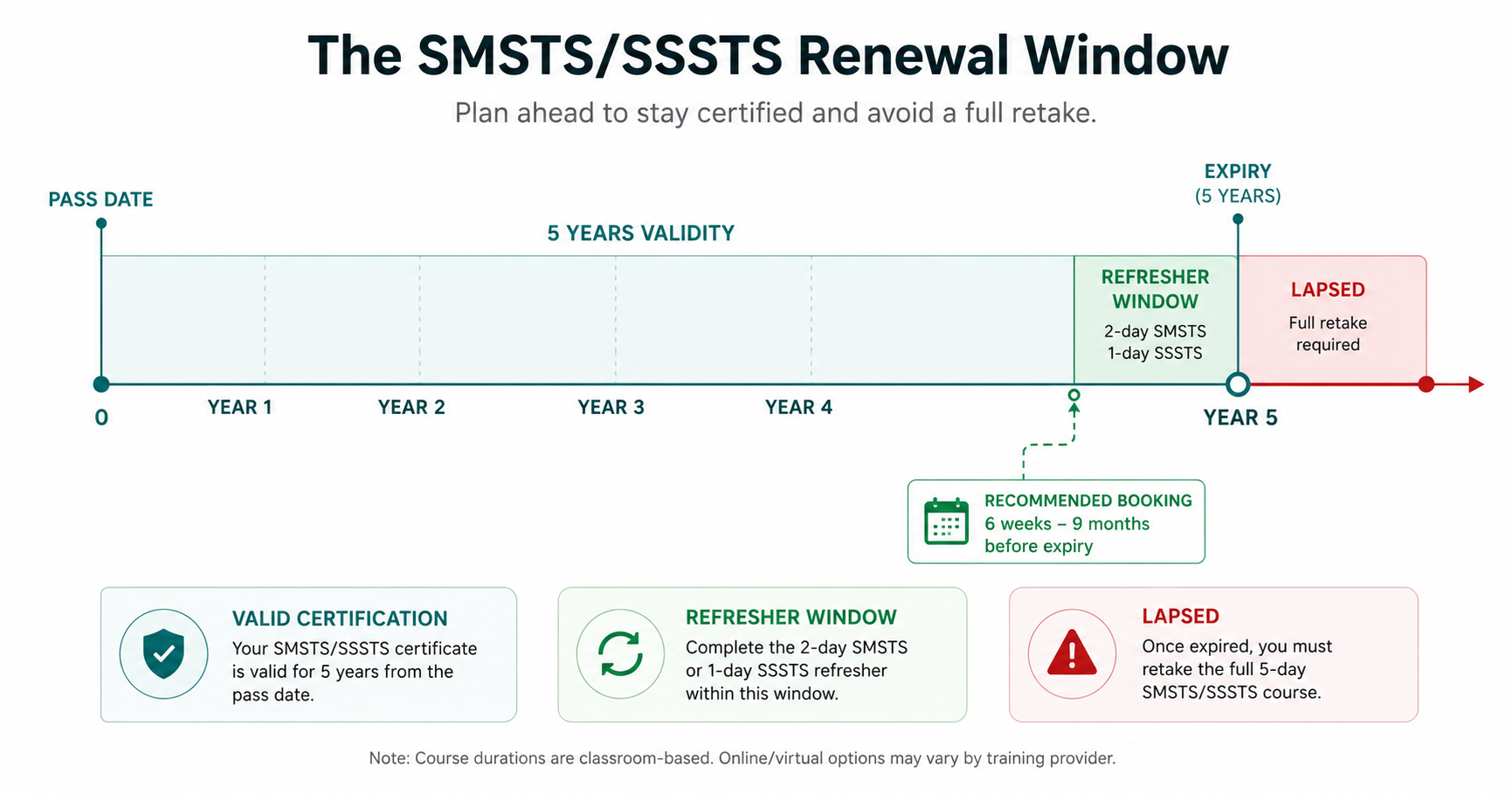
Both SMSTS and SSSTS certificates are valid for five years from the pass date printed on the certificate. During those five years the holder can carry the qualification on tender pre-qualification documents (PQQs), present it at induction, and use it to evidence competence.
After five years the certificate is no longer accepted as current. To stay qualified, the holder must renew within the five-year window — and the renewal route depends entirely on whether they act before or after expiry.
The Refresher vs the Full Retake
Inside the five-year window, renewal is a short CITB refresher:
- SMSTS Refresher — two days. A recap of the syllabus with emphasis on regulatory changes and recent incident lessons, plus an end-of-course assessment. Passing issues a new five-year certificate.
- SSSTS Refresher — one day. A syllabus recap focused on legislative changes, with a written assessment. Passing renews for a further five years.
Both refreshers require the candidate to hold an in-date original certificate at the time of attendance. That is the pivotal rule. If the certificate has lapsed, the refresher route is generally no longer available and the holder must retake the full course — five days for SMSTS, two for SSSTS. A short update becomes a full retake purely because of timing.
The Grace Period Confusion — and the Safe Rule
Here's where site managers get genuinely misled. Sources disagree on whether CITB offers a grace period after expiry. Some training providers describe a six-month post-expiry window during which the refresher can still be taken; others state firmly that there is no grace period — that the certificate must be in date on the day of the refresher, and even one day past expiry forces the full course.
Because the guidance is inconsistent and the consequence of getting it wrong is severe, the only safe operating rule is to treat the certificate as needing to be in date when the refresher is taken — and never to rely on a grace period. Providers themselves overwhelmingly advise booking before expiry for exactly this reason. If your own certificate has already lapsed, don't assume a grace period exists; confirm your exact position with a CITB-approved provider before booking, because the wrong assumption can mean paying for a refresher you're not eligible to sit.
The practical takeaway is the same either way: renew before expiry and the ambiguity never affects you.
Why These Renewals Get Missed
Five years is a long time, and that's precisely the problem:
- The horizon is too far away to stay top of mind. A renewal five years out doesn't sit in anyone's near-term planning, so it drifts until it's suddenly imminent.
- People track the wrong thing. Attention goes on CSCS cards, which are checked at every gate, while the SMSTS/SSSTS certificate — checked mainly at appointment — quietly counts down. (For gate-side card control, see how to stop expired CSCS cards reaching site.)
- Booking has lead time. Course availability, day-release scheduling around a live site, and possible rescheduling all take time. Leaving it to the last week risks the certificate lapsing before a place is available.
- Managers assume flexibility that may not exist. The belief that "there's always a grace period" is exactly what turns a two-day refresher into a five-day retake.
How to Track Renewals Across a Team
If you're responsible for a team of managers and supervisors, the five-year cycle applies to each of them on different dates — which is unmanageable from memory. A reliable approach:
- Record the pass date and calculate the expiry for every SMSTS and SSSTS holder, not just your own.
- Set an advance alert. Provider guidance ranges from six weeks to six-to-nine months before expiry; the longer lead time is safer because it absorbs illness, travel, and course cancellations.
- Book the refresher inside the window, ideally in the final few months, so the new five-year certificate runs on from the old one with no gap.
- Keep the evidence — the certificate and pass confirmation — where it can be produced for PQQs and site appointment checks.
- Track these alongside other credentials (CSCS, first aid, role tickets) rather than in a separate list, so nothing is siloed — ideally in your construction training matrix.
Why This Matters for UK Construction in 2026
Under CDM 2015, duty holders must demonstrate competence, and for principal contractors and site managers, maintaining valid certification reduces legal exposure in the event of enforcement or investigation. Clients and principal contractors increasingly verify certification before appointing someone to a role — so a lapsed SMSTS isn't just a personal admin failure, it can mean being turned away from a role or removed from a site.
The wider shift is that competence is judged on current, provable evidence rather than "I did the course once." A five-year-old certificate that expired last month proves nothing. Keeping renewals current — and being able to show it instantly — is part of the same governance discipline that audits and PQQs test. For the broader audit picture, see our guide on construction audit and PQQ training evidence.
Never Lose a Refresher Window Again
TrainMeUK tracks certificates like SMSTS and SSSTS with their expiry dates and sends reminders before they lapse — so the two-day refresher never becomes a five-day retake.
How TrainMeUK Helps
TrainMeUK lets you record external certificates — including SMSTS and SSSTS — with their expiry dates, and sends reminders before they lapse, with manager review to confirm each one. Instead of a five-year renewal drifting out of sight, it surfaces in good time to book the refresher inside the window.
Because these sit in the same record as CSCS cards, courses delivered through the platform, and other tickets, a manager sees each person's full competence picture in one place rather than tracking certificates across separate spreadsheets. For firms using Site Management, required certificates can also be tied to site access, so an expired credential is flagged rather than assumed valid. You decide which certificates each role requires and the renewal lead time; the platform keeps the dates visible and produces the evidence when a PQQ or appointment check calls for it.
Final Takeaway
The SMSTS refresher is short and cheap — but only if you catch it in time. Miss the window and the certificate that took two days to renew takes five to rebuild. Track the date, not just the card.
Related Articles
How to Build a Construction Training Matrix
Track every certificate and expiry in one place.
Read More →How to Stop Expired CSCS Cards Reaching Site
Verification and expiry control at the gate.
Read More →CDM 2015 Explained for Principal Contractors
Duties, F10 thresholds, and competence evidence.
Read More →CDM Training and Competence by Role
Who needs what under CDM 2015.
Read More →Frequently Asked Questions
How long are SMSTS and SSSTS certificates valid for?
Both are valid for five years from the pass date printed on the certificate. Within that window you renew with a short refresher — two days for SMSTS, one day for SSSTS — which issues a new certificate valid for a further five years. After five years the certificate is no longer accepted as current evidence of competence.
What happens if my SMSTS certificate expires?
If your certificate lapses, you generally lose eligibility for the two-day refresher and must retake the full five-day SMSTS course. That means significantly higher cost, more time away from work, and a period during which you can't evidence competence for the role on major sites. The equivalent applies to SSSTS, where a lapse means retaking the full two-day course instead of the one-day refresher.
Is there a grace period for renewing SMSTS or SSSTS after expiry?
The guidance is inconsistent — some providers describe a six-month post-expiry grace period, while others state firmly that there is none and the certificate must be in date on the day of the refresher. Because the sources conflict and the cost of getting it wrong is a full retake, the safe rule is to treat the certificate as needing to be in date when you take the refresher and to renew before expiry. If yours has already lapsed, confirm your exact eligibility with a CITB-approved provider rather than assuming a grace period applies.
When should I book my SMSTS refresher?
Book inside the five-year window and well before the expiry date — provider guidance ranges from six weeks to six-to-nine months ahead. The longer lead time is safer because it builds in a buffer against illness, travel problems, or course cancellations that could otherwise push you past the deadline. Renewing in the final few months means your new five-year certificate runs on from the existing one with no gap in cover.
Are SMSTS and SSSTS legally required?
Neither is a legal requirement in the strict sense, but both are contractually required on virtually every significant UK construction project, so in practice they function as mandatory for management and supervisory roles. Under CDM 2015, duty holders must demonstrate competence, and continuous SMSTS/SSSTS certification is a common and widely accepted way of evidencing it — which is why principal contractors and clients verify it before appointing someone to a role.
Track the Five-Year Clock for Your Whole Team
See how TrainMeUK records every certificate's expiry and warns you in advance, so refresher windows are never missed across your managers and supervisors.
Sources: CITB — SMSTS; CITB — SSSTS; CDM Regulations 2015.