
Introduction
Most site teams believe they're checking CSCS cards properly because someone looks at the card at induction. It feels like a check. It isn't a reliable one.
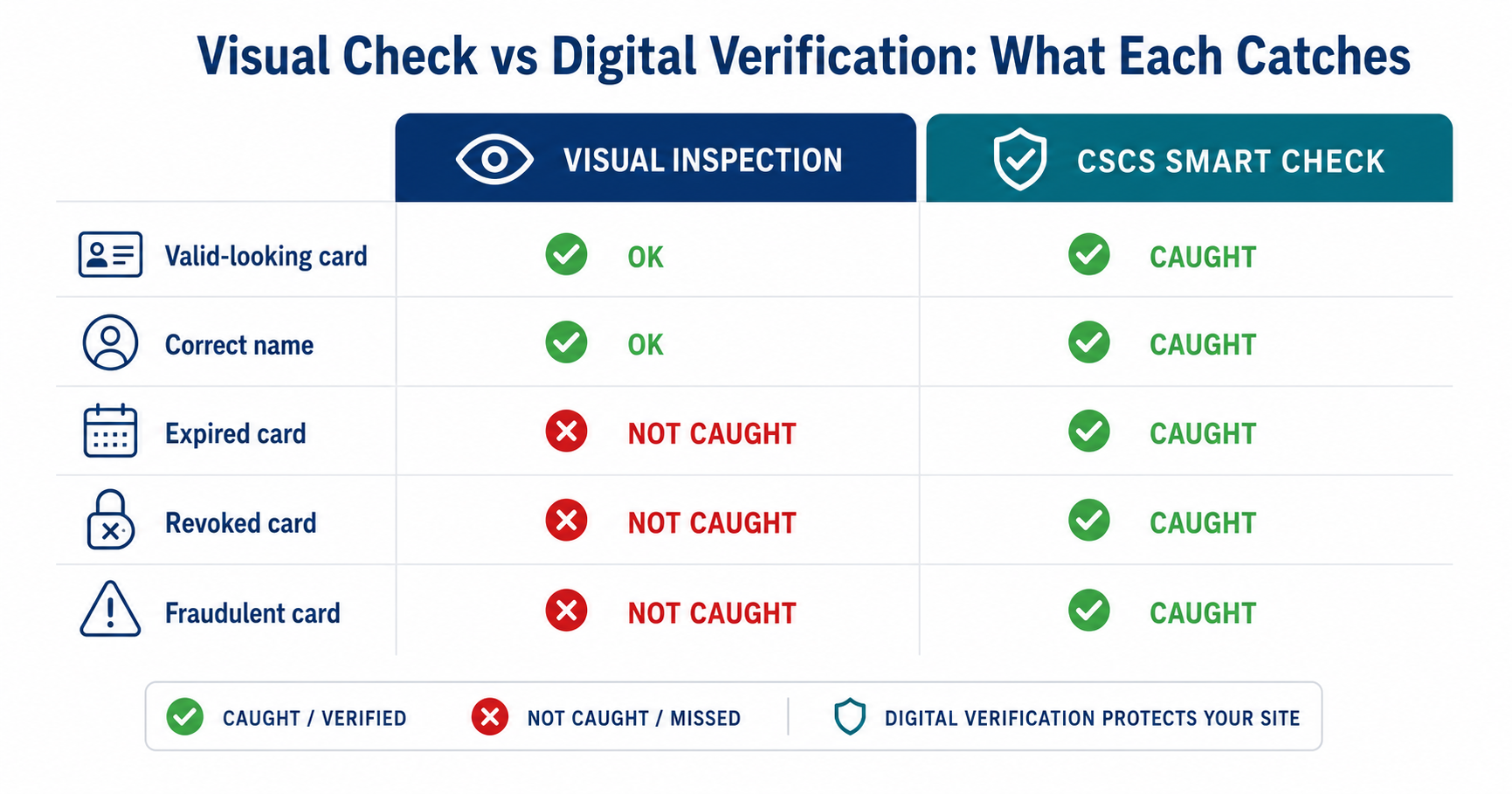
A visual inspection cannot detect a card that has been revoked, fraudulently obtained, or has simply expired since it was last seen. The card in someone's wallet can look perfect and be worthless. And because a physical card carries its printed expiry date but nothing that updates when the underlying status changes, the only way to know a card is genuinely valid right now is to verify it against live data.
That gap — between a card that looks fine and a card that is fine — is where expired credentials reach site. This guide explains how verification actually works in 2026 and how to build a process that closes the gap. For the wider record-keeping picture, see our guide on the construction training matrix. Expiry dates belong with the rest of the worker record — see CSCS tracking in construction training software.
What a CSCS Card Actually Proves
A CSCS card does three things at once: it indicates what kind of work the holder is qualified to do, what level of supervisory responsibility they can take, and that they've passed the relevant CITB Health, Safety and Environment test.
What it does not do is guarantee site access. Holding a card is not the same as being cleared for a specific site or task. The principal contractor decides whether a worker gets on, based on the correct card for the occupation plus any site-specific induction, permit, or task competence. A labourer at a general induction may need only the right card, ID, and induction; a worker for confined-space, lifting, hot works, or plant operation needs additional evidence the card doesn't cover. The card supports access — it doesn't replace every competence requirement.
Why Expired Cards Slip Through
Expired and invalid cards reach site for predictable reasons, and none of them are about people being careless:
- Cards expire mid-project. A card verified at induction can lapse weeks or months into a long-running job. If checks only happen at induction, nobody catches it.
- The worker assumes the card is enough. They think "I have a card," the subcontractor assumes the principal contractor will sort it, and the gap only surfaces at the gate.
- Digital cards create false confidence. A digital CSCS card is valid where the site accepts digital verification, but it doesn't help if the phone is flat, the app won't open, the name doesn't match the ID, or the card has quietly expired.
- Visual checks miss what matters. A revoked or fraudulently obtained card looks identical to a genuine one. Only digital verification catches it.
The common thread is that a one-off check at the start doesn't protect a site whose workforce and credentials change constantly.
How to Verify a CSCS Card in 2026
There are two official routes, and the difference between them matters at scale.
Manual verification uses the CSCS Card Checker on the CSCS website (requires the registration number and surname) or the Smart Check app to scan the QR code. Both are free with no limit on checks. Usefully, the checker returns expired as a distinct status — so you can tell a lapsed card apart from a counterfeit one that returns not found.
CSCS Smart Check is the verification platform run by the CSCS Alliance and is the only system that verifies all 2.3 million cards carrying the CSCS logo. By early 2026 it had passed 60 million scans, and its API is embedded in the site-access and induction systems of major contractors including Mace, Wates, Morgan Sindall and Balfour Beatty. The API route allows verification to be built directly into a site's access process rather than run card-by-card by hand — and a 2026 data upgrade added site-level detail such as the read reason, site ID, and GPS coordinates of each check.
Crucially, visual inspection alone will not detect fake, revoked, or fraudulently obtained cards. Digital verification is the only method that does.
The Principal Contractor's Duty to Check
Under CDM 2015, the principal contractor has a duty to confirm the competence of people on site — and card verification is part of discharging that duty. The Building Safety Act has sharpened the point: contractors are responsible for ensuring everyone on site is trained and qualified for their role, and major principal contractors are scrutinising site competence more heavily as a result. For how that maps to role-based competence, see CDM training and competence by role.
A refusal to present a card for verification is legitimate grounds to deny site access until proof of qualification is provided — and that refusal and the action taken should be documented in your site records. Accepting a forged card is not a minor lapse: counterfeit cards are a criminal matter under the Fraud Act 2006, and employers who knowingly accept them risk prosecution, loss of insurance cover, and removal from principal contractor frameworks.
Building a Check Process That Doesn't Fail
A reliable process checks at the right moments, not just once:
- Verify every card at induction — digitally, not visually.
- Re-check before expiry, not after. Track each card's expiry date and act on it with lead time rather than discovering the lapse at the gate.
- Spot-check during the project. The industry norm is to verify at induction and check again before the worker leaves; long-running sites often build quarterly re-checks into the audit schedule to catch mid-project expiries and role changes.
- Tie the check to access. The strongest control is one where an expired or missing credential prevents access automatically, rather than relying on someone to notice.
- Keep the evidence. Every check, and every refusal, should leave an audit trail — because if the project is later questioned after an incident or inspection, you need to show access was controlled and workers were checked before starting work.
The Renewal Dates to Track
Stopping expired cards is easier when you track the dates that actually cause the lapses:
- CSCS card expiry — most skilled cards (Blue, Gold, Black) are valid five years, but several types run shorter, so record the real date. Cards can be renewed from six months before expiry up to six months after.
- The CITB HS&E test — the hidden trap. The test must have been passed within the two years before a card application or renewal, and because people watch the card date, the test lapses unnoticed and delays renewal. The test rose to £23.50 per attempt from 1 April 2026.
- Site-specific inductions — these expire when a worker hasn't been on that site recently, and each site tracks its own.
Those dates belong in your construction training matrix, not in a separate tracker — and the alert windows that catch them early are covered in construction training expiry and refresh cycles.
Why This Matters for UK Construction in 2026
Construction competence is increasingly judged through evidence, not assumptions. A site can no longer say a worker "looked experienced" or "had a card" — it needs a controlled process showing the right people were appointed, checked, and managed. With the Building Safety Act in force and principal contractors tightening competence scrutiny, the ability to prove that every person on site was verified — and that anyone without valid credentials was stopped — has moved from good practice to expectation.
Completion of a check isn't enough on its own; what protects you is a verifiable record that checks happened, at the right times, with the right outcome. For how this fits the broader audit picture, see our guide on construction audit and PQQ training evidence.
Catch the Lapse Before the Gate Does
TrainMeUK tracks external certificates like CSCS cards with expiry dates and reminders before they lapse — and with Site Management, an expired or missing credential is flagged at the gate, captured in a full audit trail.
How TrainMeUK Helps
TrainMeUK lets you upload and validate external qualifications — including CSCS cards — and track them against their expiry dates, with reminders before a credential lapses and manager review to confirm each one. That turns card status from something checked reactively at induction into something monitored continuously.
For firms using the Site Management module, those requirements are tied to site access. At the gate, a compliance scan checks a worker's training, certificates, and risk-assessment status before approving entry — allow, deny, or allow with conditions — and every decision is captured in an audit trail. You set which credentials each role and site require; the platform enforces the rule at the point of entry rather than leaving it to a visual glance. (Note that formal card authenticity verification against the CSCS database is provided by CSCS Smart Check; TrainMeUK manages the currency, requirements, and access-control side of the record.)
Final Takeaway
A card that looks valid and a card that is valid are two different things — and only one of them keeps you compliant. Check the status, not the plastic, and check it before the gate does it for you.
Related Articles
How to Build a Construction Training Matrix
Track every credential and expiry in one place.
Read More →Construction Compliance Training in the UK
Mandatory scope and audit readiness.
Read More →Construction Audit & PQQ Training Evidence
Records that stand up to client and HSE scrutiny.
Read More →Best Construction LMS Software UK
How platforms track cards, and where live verification still sits outside the LMS.
Read More →SMSTS & SSSTS Renewal Intervals
Why a one-day lapse can force a full five-day retake.
Read More →Frequently Asked Questions
How do I check if a CSCS card is valid?
Use CSCS Smart Check — the platform run by the CSCS Alliance that verifies all 2.3 million cards carrying the CSCS logo — via its free app, the website Card Checker (which needs the registration number and surname), or the API built into site access systems. A visual inspection is not enough on its own, because it cannot detect a card that has been revoked, fraudulently obtained, or expired. The website checker returns "expired" as a distinct status, so you can tell a lapsed card apart from a counterfeit one, which returns "not found".
Can you tell if a CSCS card is expired just by looking at it?
Not reliably. A card carries its printed expiry date, but that doesn't reveal whether the card has been revoked or fraudulently obtained, and a card seen at induction may lapse later in a long project. Only digital verification against live CSCS data confirms a card's real-time status, which is why visual-only checks let expired and invalid cards through.
Whose responsibility is it to check CSCS cards on site?
Under CDM 2015, the principal contractor has a duty to confirm the competence of people on site, and card verification is part of meeting that duty. The Building Safety Act has reinforced this by making contractors responsible for ensuring everyone on site is trained and qualified for their role. A worker who refuses to present a card for verification can be denied access until they provide proof, and that refusal should be documented.
What happens if you let someone on site with an expired CSCS card?
An expired card is not valid for site access and the work should not continue until it's renewed. Beyond the immediate safety and compliance exposure, if the project is later questioned after an incident or inspection you need to show that access was controlled and workers were checked — and knowingly accepting a forged card is a criminal matter under the Fraud Act 2006, carrying risks including prosecution, loss of insurance cover, and removal from contractor frameworks.
How often should CSCS cards be re-checked during a project?
The industry standard is to verify every card at induction and to check again before the worker leaves the project. For long-running sites, many principal contractors build quarterly re-checks into their audit schedule to catch cards that expire mid-project and workers who have changed roles since induction. Tracking each card's expiry date with advance reminders lets you re-check before a lapse rather than discovering it at the gate.
Turn Card Checking into a Controlled Process
See how TrainMeUK tracks credential expiry, warns you in advance, and — with Site Management — stops an expired ticket reaching the gate with a full audit trail.
Sources: CSCS — Smart Check reaches 60 million scans; CSCS Smart Check FAQs; CSCS Group — Smart Check; CSCS — CITB price changes (April 2026).