
Introduction
Most construction firms think they have their training under control because they keep a spreadsheet. It looks complete. Every name has a row, every ticket has a column, and the cells are mostly filled in.
The problem is that a spreadsheet records what happened — it can't tell you what's about to go wrong. A CSCS card that expires next Tuesday looks identical to one valid for three more years unless someone manually checks the date. By the time a gap shows up, it's usually at the gate on a Monday morning, or worse, during a principal contractor audit or after an incident.
A construction training matrix fixes that — but only if it's built for the realities of construction, not adapted from a generic office training tracker. This guide covers the credentials it must hold, the renewal intervals that trip people up, and how to build one that stands up when a client checks. For the wider governance picture, see our guide on construction compliance training. When the spreadsheet is no longer enough, the same records live in construction training software.
Free download: the construction training matrix template (Excel)
Start from a matrix that's already built the right way — not a blank spreadsheet. It comes with role-based rows and every column that catches people out: CSCS card, the CITB HS&E test tracked as its own field, SMSTS/SSSTS, role tickets and one column per site induction, with clear status tracking ready to go. Add your people, delete the example rows, and you have a working matrix in minutes.
Get the Free Excel TemplateWhat Is a Construction Training Matrix?
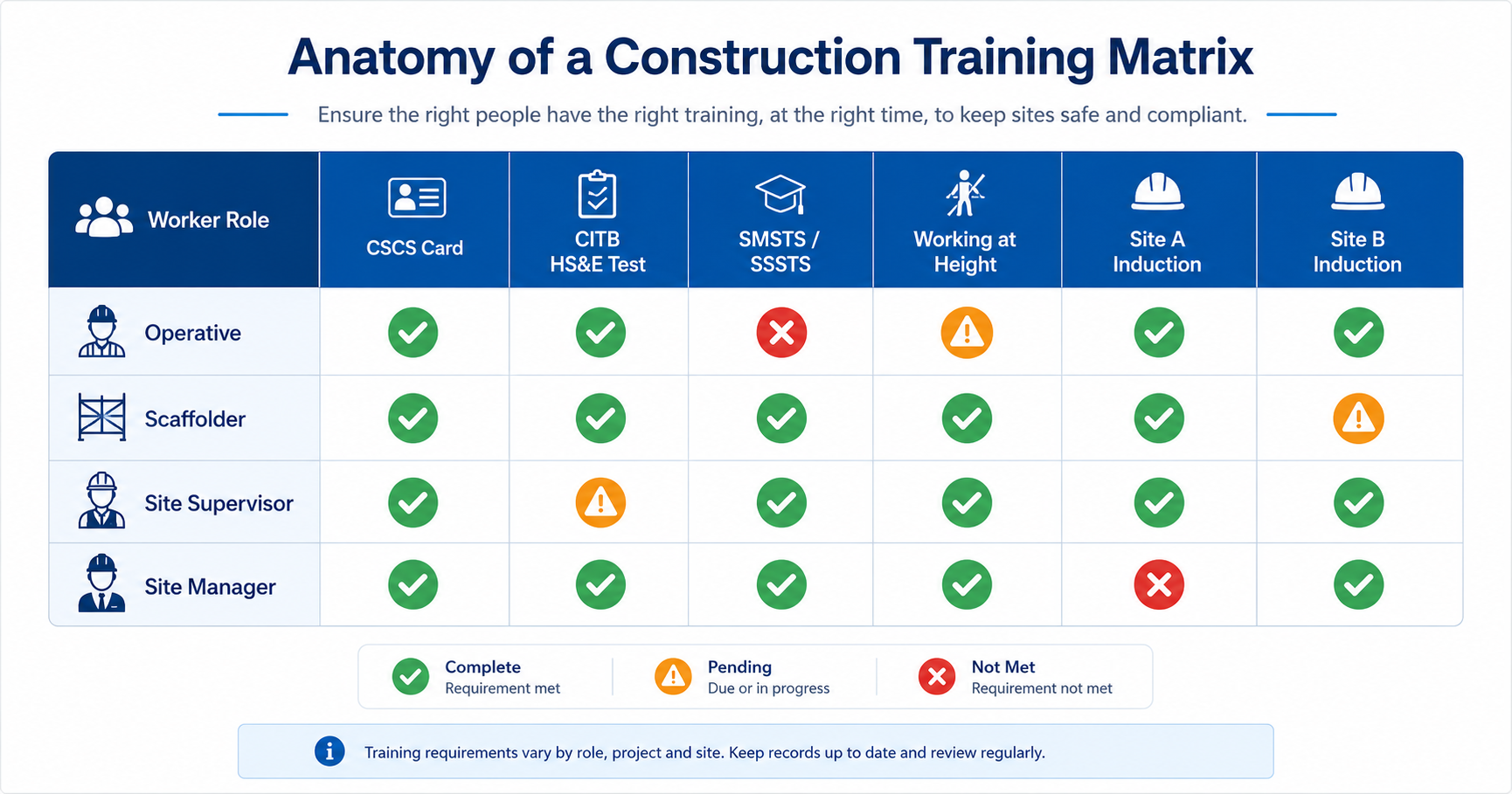
A training matrix is a grid: people down one axis, required training and credentials across the other, and the status of each in the cells. At a glance it should answer three questions — who is qualified for what, whose credentials are current, and who is missing something they need for the work in front of them.
In construction, the matrix carries more weight than in most sectors because the credentials it tracks are the difference between site access and a turned-away operative. It is not an HR nicety; it is the operational record that decides who can work tomorrow.
Why Construction Needs a Different Matrix
A generic health and safety matrix assumes a stable workforce doing consistent work in one location. Construction breaks all three of those assumptions.
Teams move between sites, the workforce churns constantly, and every site can impose its own rules. An operative working across three sites in a month may need three separate inductions, each tracked against that specific site. Agency workers and subcontractors rotate in and out — and under CDM your duties to them match those for direct hires; see managing agency and temporary workers' compliance. And unlike an office refresher that's merely good practice, a lapsed CSCS card means no site access — a direct, immediate operational cost.
That is why a construction matrix has to be role-and-risk based, not a blanket checklist. What a scaffolder needs differs from what a site manager needs, which differs again from what a visiting designer needs. The matrix has to map training to actual activity exposure and responsibility, including supervisory and management duties — see who needs what under CDM 2015 — rather than applying one list to everyone.
The Credentials Your Matrix Must Track
At minimum, a UK construction training matrix should hold the following for every person who accesses your sites:
- CSCS card — type, colour, and expiry date. Most skilled cards (Blue, Gold, Black) are valid for five years, but several card types run shorter, so record the actual expiry rather than assuming five years.
- CITB Health, Safety and Environment (HS&E) test — track this separately from the card. The test must have been passed within the two years before a card application or renewal. Operatives regularly let the test lapse between card renewals, then hit a delay at renewal time because they have to rebook and pass it again first.
- SMSTS and SSSTS — the CITB site management (SMSTS) and supervisor (SSSTS) safety certificates. Technically not a legal requirement, but contractually required on virtually every significant UK project, so treat them as mandatory for those roles. For the five-year refresher window and the no-grace-period trap, see SMSTS and SSSTS renewal intervals.
- Role-specific tickets — asbestos awareness, working at height, manual handling, IPAF, first aid, and any high-risk activity competence relevant to the person's work.
- Site-specific inductions — one column per active site, archived when the site completes. Principal contractors and the HSE expect a retrievable, site-specific record — see what principal contractors actually check on induction records.
The exact list depends on scope of work, role, and site or client standards. There is no single universal list for every UK construction business, which is precisely why a role-based matrix beats a fixed template.
The Renewal Intervals That Catch People Out
The single most common cause of a gate refusal is a credential that expired while everyone assumed it was fine. Build alert lead times into the matrix rather than checking dates reactively:
- CSCS cards and SMSTS/SSSTS — set an alert around three months before expiry. Renewals involving a resit or NVQ evidence need real lead time.
- The CITB HS&E test — the quiet one. It's valid for two years for application purposes, and because people focus on the card date, the underlying test lapses unnoticed.
- Annual refreshers (first aid, some site-specific training) — around six weeks' notice is usually enough.
Two figures worth knowing for 2026 budgeting: the CSCS card application fee is £36, and the CITB HS&E test rose to £23.50 per attempt from 1 April 2026. A failed test is another £23.50 plus travel and lost time — which is why proactive renewal scheduling saves money, not just admin. For the wider logic of refresh windows and escalation, see construction training expiry and refresh cycles.
How to Build the Matrix (Step by Step)
- List every person. Include your own payroll and every regular subcontractor and agency worker. Subcontractors are your liability on sites you control, so they belong in the matrix.
- Define the columns by role and risk. Map required credentials to what each person actually does, not a blanket list. A supervisor's row looks different from a labourer's.
- Record specifics, not just "valid". Log card type, colour, and actual expiry date — and track the HS&E test as its own column.
- Add a column per active site for inductions. Archive those columns when the site completes.
- Set alert thresholds (three months for cards and SMSTS/SSSTS, six weeks for annual refreshers) and review monthly, because the workforce changes constantly.
- Decide how you'll prove it. A matrix that can't produce evidence on demand fails the one test that matters — the audit.
The free Excel template gives you this structure out of the box — replace the example rows with your own people and sites.
Where Spreadsheets Break Down
A spreadsheet is a fine place to start, and for a handful of operatives on one site it may be all you need. The trouble begins as soon as the numbers grow.
Spreadsheets don't send reminders, so someone has to remember to check them. They don't verify anything — a typed "valid" is only as reliable as the person who typed it. They can't stop an expired card reaching the gate, because the gate and the spreadsheet aren't connected — see how to stop expired CSCS cards reaching site. And when the HSE or a principal contractor asks for evidence, you're exporting, formatting, and hoping the data was kept current — often across several files that have quietly drifted out of sync.
The gap between a calm audit and a scramble is rarely the quality of the training — it's whether currency, ownership, and enforcement can be proved instantly. That's the point at which a static grid stops being enough.
Why This Matters for UK Construction in 2026
Construction is one of the most scrutinised operating environments in the UK. During onboarding checks, pre-qualification questionnaires (PQQs), ISO reviews, and incident follow-ups, clients and auditors test whether your controls are current and enforceable — not whether you can export a list of certificates.
Completion shows that training happened. Audit readiness shows controlled governance: scope is defined, currency is tracked, gaps are visible, exceptions are owned, and enforcement is evidenced. A training matrix is where that governance lives — or where it falls apart. For principal contractors managing subcontractor evidence specifically, see our guide on managing subcontractor training records.
From Spreadsheet to Single Source of Truth
TrainMeUK holds every person's training and external certificates — like CSCS cards — in one place, with expiry dates tracked and reminders before they lapse. It's the matrix, kept current automatically, ready to evidence on demand.
How TrainMeUK Helps
TrainMeUK replaces the spreadsheet matrix with a live system. You can upload and validate external qualifications — CSCS cards, first aid, and other tickets — and track them against expiry, with reminders sent before a credential lapses and manager review to confirm each one. Courses you deliver through the platform are recorded automatically alongside those external credentials, so training and tickets live in one record rather than several files.
For firms using our Site Management module, those requirements can be tied to site access: a worker with an expired or missing credential is flagged at the gate, with the check captured in a full audit trail. You define which credentials each role and site require; the platform keeps the record current and produces the evidence when someone asks for it.
Final Takeaway
A spreadsheet tells you what happened last year. A living matrix tells you who can work tomorrow. In construction, that difference is the one that decides whether Monday morning starts with a full crew or a turned-away operative.
Related Articles
Construction Compliance Training in the UK
Mandatory scope, role-based assignment, and audit readiness.
Read More →Managing Subcontractor Training Records
Controlling subcontractor evidence for CDM and site audits.
Read More →CDM 2015 Explained for Principal Contractors
Duty holders, F10, documents, and competence evidence.
Read More →CDM Training and Competence by Role
Who needs what under CDM 2015.
Read More →How to Stop Expired CSCS Cards Reaching Site
Why visual checks miss expired and fake cards — and how to verify properly.
Read More →SMSTS & SSSTS Renewal Intervals
The five-year window, refresher vs retake, and the grace-period myth.
Read More →Agency & Temporary Workers' Compliance
Same CDM duty whether payroll, self-employed, or agency.
Read More →Site Induction Records
What principal contractors actually check — and how to prove it.
Read More →Evacuation Roll Call & Fire Register
Accounting for everyone on site when the alarm sounds.
Read More →Frequently Asked Questions
What should a construction training matrix include?
At minimum it should track each person's CSCS card (type, colour, and expiry), their CITB Health, Safety and Environment test date tracked separately, any role-specific tickets such as SMSTS, SSSTS, asbestos awareness or working at height, and site-specific inductions with one column per active site. Include both your own payroll and any regular subcontractors, since subcontractors are your liability on sites you control.
How long is a CSCS card valid for?
Most skilled CSCS cards — Blue, Gold and Black — are valid for five years, though several card types run shorter (some temporary cards last one year or less), so you should always record the actual expiry date rather than assuming five years. Cards can be renewed from six months before expiry up to six months after, provided the holder has passed the relevant CITB HS&E test within the previous two years.
Why track the CITB HS&E test separately from the CSCS card?
Because they expire on different cycles. The HS&E test must have been passed within the two years before a card application or renewal, but people focus on the card's expiry date and let the underlying test lapse. When renewal time comes, they then face a delay because they have to rebook and pass the test before the card can be renewed. Tracking both dates separately gives you the lead time to avoid that.
Is a spreadsheet good enough for tracking construction training?
For a few operatives on a single site, a spreadsheet can work. It stops being reliable as the workforce grows because it doesn't send reminders, doesn't verify credentials, can't prevent an expired card reaching the gate, and takes time to turn into audit evidence — often across several files that drift out of sync. The risk is that everything looks fine until an audit or an incident exposes a gap.
What do principal contractors check during an audit or PQQ?
They usually check who is in scope, whether the required people are in date for the current work, how subcontractor evidence is managed, and what escalation happens when training is overdue. The emphasis is on whether your controls are current and enforceable, not simply whether training was once completed — so being able to prove currency, ownership, and enforcement instantly matters more than the volume of certificates you hold.
Stop Chasing Expiry Dates Across Spreadsheets
TrainMeUK tracks every credential, warns you before it lapses, and — with Site Management — can stop an expired ticket reaching the gate. See how it replaces the manual matrix.
Sources: CSCS — applying for cards; CSCS — CITB price changes (April 2026); CITB — SMSTS; CITB — SSSTS.