
Introduction
Every site does inductions. Far fewer can produce the record for a specific worker, quickly, when someone asks.
Under CDM 2015, the principal contractor must ensure every worker receives a suitable, site-specific induction — and the HSE expects you to be able to demonstrate that inductions were delivered and recorded. An induction that happened but can't be evidenced, or one that was generic enough to apply to any site, doesn't meet the standard. In an investigation, the induction record is typically the first document requested, because it's the clearest test of whether a site controlled who came on and what they were told.
This guide covers what principal contractors actually check — in the induction itself and in the record behind it. For how induction fits your wider training records, see our guide on the construction training matrix. Principal contractors who need those records retrievable by site can hold them in construction training software.
Why the Induction Record Is the First Thing Checked
The induction record is a proxy for something bigger: whether the site knew who was on it and made sure they understood the risks before they started work. That's why it's the first thing an inspector or investigator reaches for.
A useful field test that safety professionals use: twenty-four hours after induction, ask a new worker to name the assembly point and the on-shift first aider. If they can't, the induction was a transmission, not a transfer — compliant on paper, ineffective in practice. Many inductions pass the paperwork test and fail the comprehension test, and the gap between the two is where most harm happens. Principal contractors who take it seriously check both: that the record exists, and that the content actually landed.
The Legal Duty — and Who Holds It
CDM 2015 places the duty to ensure a suitable site induction on the principal contractor on projects with more than one contractor. Two points people get wrong:
- The duty covers everyone on site, not just the principal contractor's own workers — subcontractors, agency and temporary workers included. For the same no-distinction rule applied to temporary labour, see managing agency and temporary workers' compliance.
- The duty doesn't transfer with delegation. The principal contractor may have a competent site manager, HSE advisor, or specialist subcontractor deliver parts of the induction, but the principal contractor remains accountable for ensuring it happens and is suitable.
Where there's only one contractor and no principal contractor, the induction duty still applies — it falls to that contractor. And visitors who enter operational areas need a proportionate induction too: an escorted one-off visitor needs awareness of the main hazards and controls, not the full worker induction, but they can't simply walk on unbriefed.
Why "Site-Specific" Is the Word That Matters
This is the single most common failure. The regulations don't prescribe a format, but they require the information to be appropriate to the site and the risks present — and HSE guidance (HSG150, Health and Safety in Construction) recommends inductions be tailored to the site rather than delivered as a generic slideshow that could apply anywhere.
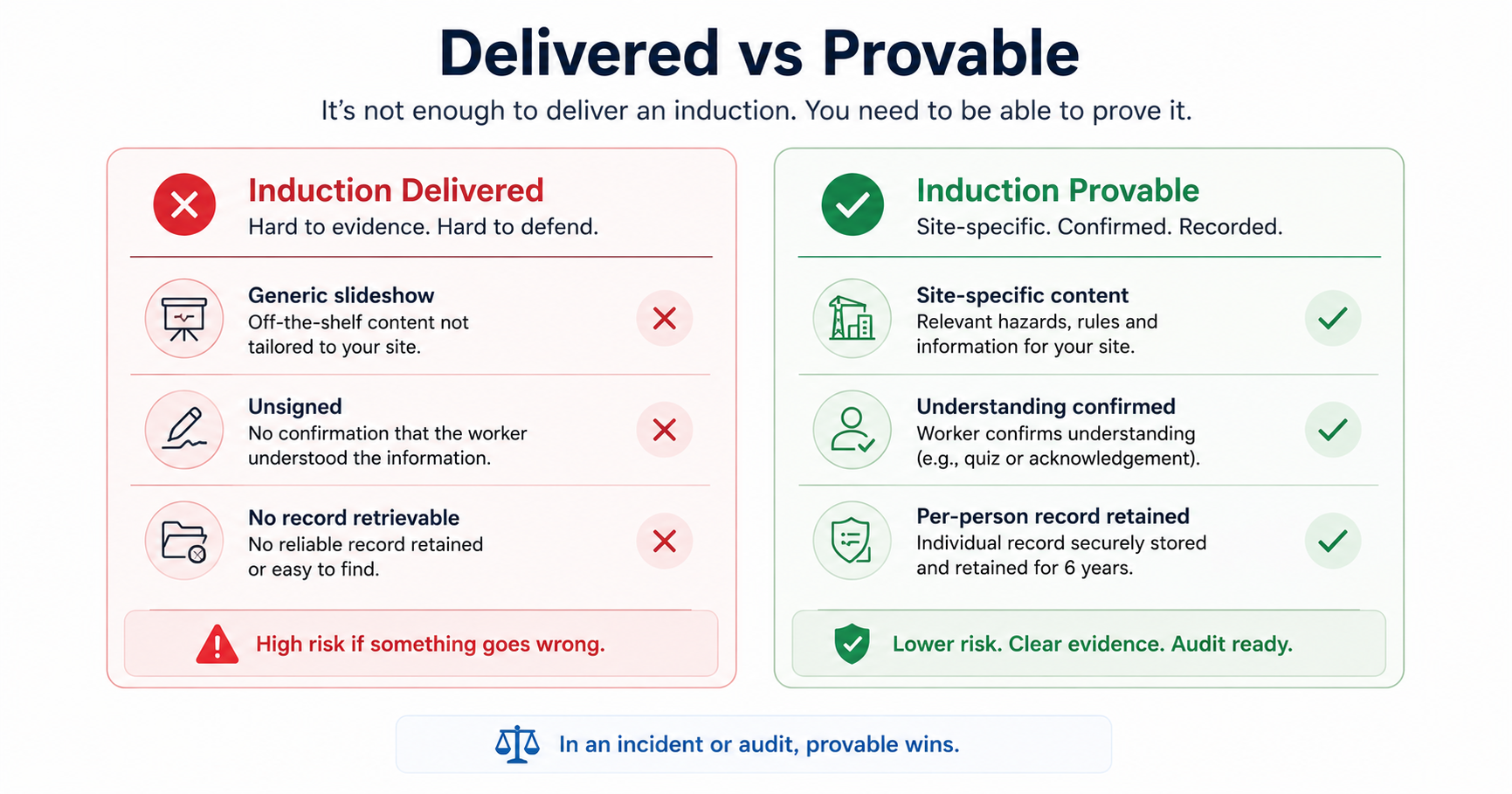
If your induction doesn't reference the actual hazards, layout, and procedures for this particular site, it doesn't meet the standard — however slick the deck. The recurring enforcement pattern is the one-size-fits-all induction: a demolition contractor and a delivery technician sit through the same 45-minute presentation that covers nothing specific to either, the record shows "induction completed," and the investigation later shows it communicated nothing useful. A record that says "done" against generic content is weak evidence; a record tied to genuinely site-specific content is strong.
The strongest current practice is hybrid: digital pre-arrival delivery for the standardisable content (which produces a consistent, auditable record automatically), followed by a short in-person walkthrough on the first day for the situational content that needs the physical context of the site.
What a Full Induction Should Cover
A suitable worker induction typically covers:
- Site-specific hazards and controls — the actual risks on this project and how they're managed.
- Emergency procedures — evacuation, fire, medical and environmental, with the assembly point physically identified.
- Site layout and restricted zones — welfare facilities, first aid posts, traffic routes, exclusion areas.
- PPE requirements — mandatory items, inspection, and replacement.
- Site rules and permits — working hours, restrictions, permit-to-work overview, rules on phones and fitness for work.
- Roles and responsibilities — site management, HSE contacts, and the right to stop work.
- Reporting procedures — how to report incidents, near misses, and hazards.
High-risk activities — confined spaces, work at height, hot works, demolition, lifting — need task-specific briefing beyond the general induction, planned and supervised by a competent person against a current risk assessment. The general induction gets someone safely onto site; it doesn't clear them for specialist work.
When You Must Re-Induct
An induction isn't necessarily once-per-person-forever. Re-induct when:
- Site conditions or risks change significantly, or a new project phase starts.
- A worker returns after an extended absence and may no longer be current on the site's arrangements.
- Someone changes role or location within the project.
- After an incident or near miss that changes the controls in place.
This is where a static sign-in sheet struggles — it records the first induction but doesn't prompt the re-induction, so returning and reassigned workers slip through.
What the Record Must Show — and How Long to Keep It
To demonstrate compliance, the induction record should show, per person: who was inducted, when, what content was covered, who delivered it, and confirmation the worker understood and acknowledged it. A signed acknowledgment is the traditional proof; a digital completion record does the same job more legibly.
On retention: induction records should be kept for the duration of the project, and ideally for at least six years afterwards — the limitation period for civil claims — because a claim or query can arrive long after the site has closed. The HSE can request these records at any time during an inspection, and if you can't produce the record for a specific named worker quickly, that's a compliance gap in itself. Paper systems are especially exposed here: lost sheets and illegible signatures turn a "we did it" into "we can't prove it."
Why This Matters for UK Construction in 2026
Failure to demonstrate inductions can result in an improvement notice or, in serious cases, prosecution — and with the Building Safety Act reinforcing that contractors are responsible for ensuring everyone on site is trained and qualified for their role, the expectation to prove controlled site access is only rising. As workforce shortages and subcontractor turnover stretch traditional in-person delivery, more principal contractors are moving to standardised digital induction systems precisely because they produce consistent content and auditable records automatically.
The underlying shift is the same one running through all construction compliance: competence and control are judged on provable evidence, not assurance. An induction you can prove — site-specific, understood, recorded, retrievable — is worth far more than one you merely delivered. For the wider audit picture, see our guide on construction audit and PQQ training evidence.
Prove Every Induction, for Every Worker
TrainMeUK records inductions and course completions per person, and — with Site Management — can tie site access to a completed induction, so no one starts work without a retrievable record.
How TrainMeUK Helps
TrainMeUK lets you deliver induction content digitally and records completion per person, with knowledge checks to confirm understanding rather than just attendance — which addresses the comprehension gap that generic sign-in sheets miss. Because completions are stored against each individual, producing the record for a named worker is immediate rather than a hunt through paper.
For firms using the Site Management module, induction and required credentials can be tied to site access via QR check-in, so a worker who hasn't completed the current site's induction is flagged at the gate, and every entry is captured in an audit trail. You design the site-specific content and decide when re-induction is triggered; the platform delivers it, records who completed it and when, and keeps the evidence retrievable for the project and beyond. (The in-person walkthrough for situational, site-specific content remains best delivered on site — the platform handles the standardisable content and the record.)
Final Takeaway
An induction that can't be proved is, for compliance purposes, an induction that didn't happen. Make it site-specific, confirm it landed, and keep the record where you can find it the moment someone asks.
Related Articles
How to Build a Construction Training Matrix
Where induction records sit alongside credentials.
Read More →Agency & Temporary Workers' Compliance
Inducting a churning workforce.
Read More →Construction Audit & PQQ Training Evidence
Records that stand up to scrutiny.
Read More →Best Construction LMS Software UK
How seven platforms build and assign a site induction.
Read More →Evacuation Roll Call & Fire Register
Where induction meets the muster-point headcount.
Read More →Frequently Asked Questions
Is a site induction a legal requirement in UK construction?
Yes. Under CDM 2015, the principal contractor must ensure every worker on a construction site receives a suitable, site-specific induction before starting work, and where there is only one contractor and no principal contractor, that duty falls to the contractor. The requirement applies to every site and every person, and because construction sites change constantly, a worker needs a fresh induction at each new site rather than a single induction when they join an employer.
Who is responsible for site inductions on a construction project?
On projects with more than one contractor, the principal contractor holds the duty to ensure inductions happen and are suitable, covering everyone on site including subcontractors and agency workers, not just their own employees. The principal contractor can delegate delivery to a competent site manager, HSE advisor, or specialist subcontractor, but the duty and accountability don't transfer with the delegation — the principal contractor remains responsible for ensuring it's done properly.
What makes a site induction "suitable" under CDM 2015?
The regulations don't prescribe a format, but they require the information to be appropriate to the site and the risks present, and HSE guidance (HSG150) recommends inductions be tailored to the specific site rather than delivered as a generic slideshow. In practice that means covering the actual hazards, layout, emergency procedures, site rules, and reporting arrangements for this particular project. A generic induction that could apply to any site — even if the record shows it was "completed" — does not meet the standard.
How long should site induction records be kept?
Induction records should be retained for the duration of the project and ideally for at least six years afterwards, which reflects the limitation period for civil claims. The HSE can request the records at any time during an inspection, and you should be able to produce the record for a specific named worker quickly. Paper records are particularly vulnerable to being lost or becoming illegible, which is why many principal contractors move to digital systems that store completions per person.
When do workers need to be re-inducted?
Re-induction is needed when site conditions or risks change significantly, when a new project phase begins, when a worker returns after an extended absence, when someone changes role or location on the project, and after an incident that alters the controls in place. This is a common gap with paper sign-in sheets, which record the first induction but don't prompt the re-induction — so returning and reassigned workers can end up working to arrangements they were never briefed on.
Turn Inductions into Retrievable, Provable Records
See how TrainMeUK delivers induction content, confirms understanding, and — with Site Management — ties site access to a completed induction.
Sources: HSE — CDM 2015 principal contractors; HSE — HSG150 Health and Safety in Construction; CDM Regulations 2015; Building Safety Act 2022.