
Introduction
There's a common assumption that agency and temporary workers are somehow the agency's problem — that because they're not on your payroll, their training and competence sit with whoever sent them.
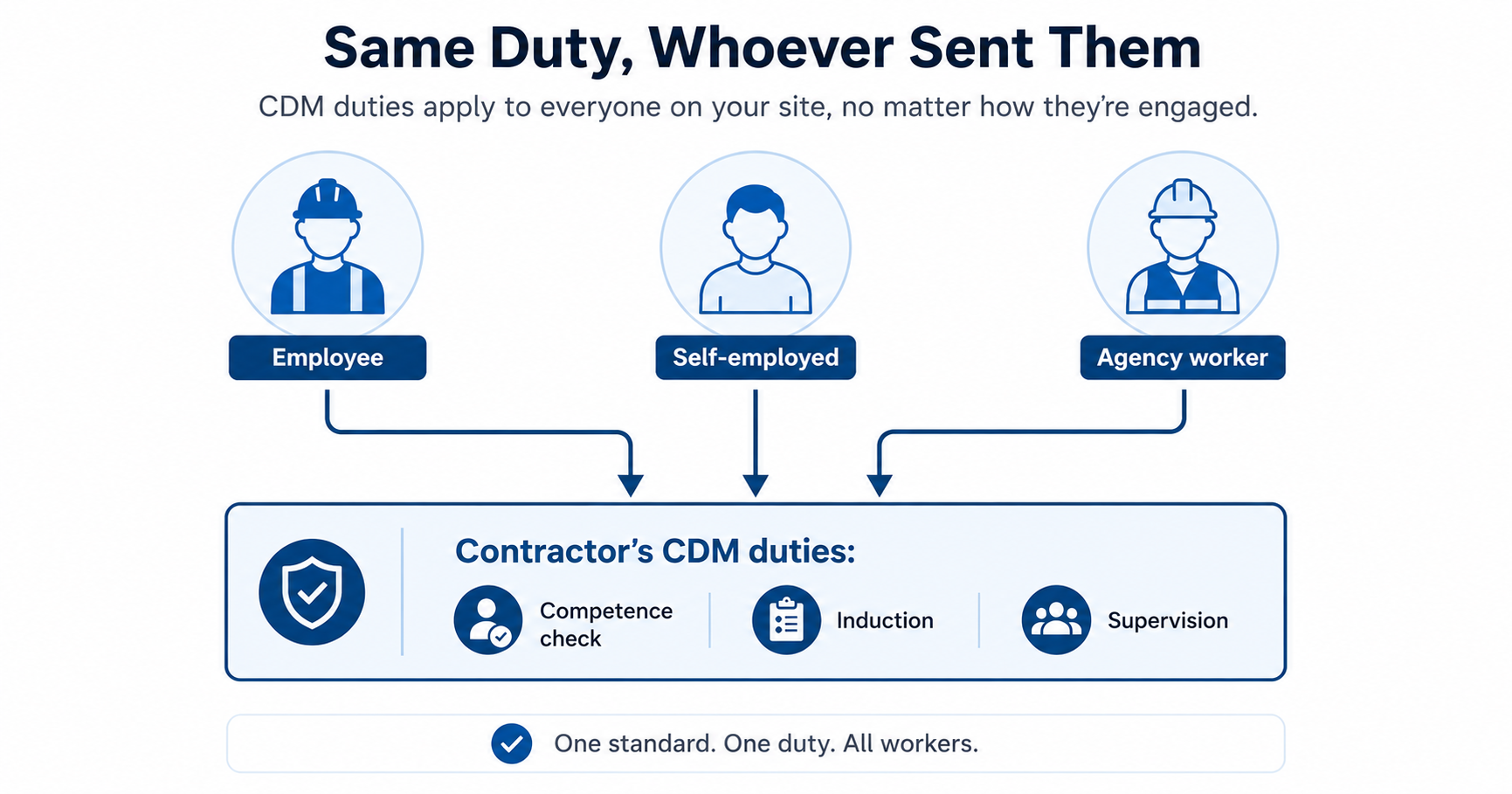
Under CDM 2015 that assumption is wrong. A contractor's duties apply to the workers under their control whether those workers are employees, self-employed, or agency workers — without distinction. The HSE is explicit on this point. The moment a temporary worker is under your control on your site, your competence, induction, and supervision duties apply to them exactly as they would to a directly employed operative.
That's a significant exposure, because agency labour is precisely the category where records are thinnest and churn is highest. This guide covers where the duty sits and how to manage it when your workforce changes week to week. For the underlying record-keeping structure, see our guide on the construction training matrix. The same problem — people who are only on site for a day — is what construction training software is built to track.
The Rule That Surprises People: No Distinction
The HSE guidance on contractor duties states plainly that the duties on contractors apply whether the workers under their control are employees, self-employed, or agency workers. There is no lighter-touch category for temporary labour.
This matters because the mental model on many sites is the opposite — that a worker sent by an agency arrives "pre-checked" and the receiving contractor can assume competence. In law, the receiving contractor who controls that person's work carries the duty to be satisfied they have the skills, knowledge, training, and experience for the task, and to provide induction, information, and supervision. The agency's involvement doesn't discharge your duty.
Who Is Responsible for an Agency Worker?
Responsibility follows control, and on a live site it can sit in more than one place at once:
- The contractor controlling the work must plan, manage, and monitor that work, only engage people with the necessary skills, knowledge, training and experience (or who are in the process of obtaining them), establish whether training is needed, and provide appropriate supervision, instruction, and information.
- The principal contractor (on projects with more than one contractor) must ensure every worker is given a suitable site induction — and that includes agency and temporary workers.
- The individual contractor must still provide a suitable site induction where the principal contractor hasn't.
- The worker has their own duties too — to only carry out work they're competent for (or are trained and supervised to do) and to make themselves aware of the site's risks.
The practical upshot: an agency worker under your control is your responsibility to verify and induct, regardless of what the agency has or hasn't done. For how competence maps by role more broadly, see CDM training and competence by role.
What You Must Confirm Before They Start
Before a temporary worker begins work, the same enquiries apply as for anyone else:
- Competence for the task — the right skills, knowledge, training, and experience, or a plan to provide the training and supervision that makes the work safe.
- The right credentials for the work and site — CSCS card of the correct type, plus any role- or task-specific tickets (working at height, asbestos awareness, plant, confined space) the job demands. (For gate-side card verification, see how to stop expired CSCS cards reaching site.)
- A site-specific induction — covering the site's particular hazards, control measures, and emergency procedures. A worker who's been on twenty sites still needs this site's induction. For what the record must show, see site induction records principal contractors check.
- Currency — that cards and tickets are in date now, not simply that they existed at some point.
None of this is different from what you'd do for a permanent hire. The difficulty is doing it reliably for someone who arrived this morning and may be gone next week.
Why Agency Compliance Is the Hardest to Track
Agency and temporary labour breaks the assumptions a training record usually relies on:
- High churn. People rotate in and out constantly, so the "who's on site" list is never stable, and a matrix built for a fixed workforce falls out of date immediately.
- Records live elsewhere. The worker's training history sits with the agency or the individual, not in your system, so you're verifying credentials you don't hold.
- Time pressure at the gate. Temporary workers often arrive at short notice to fill a gap, and the pressure to get them working can shortcut the checks.
- Split responsibility invites assumption. Because the agency, the subcontractor, and the principal contractor are all involved, each can assume another has done the checking — and the gap surfaces only after an incident or audit.
- Inductions expire. A worker who leaves and returns weeks later may need re-inducting, which is easy to miss when they're treated as "already known."
The result is that agency workers are frequently the least-documented people on site — and, because of the no-distinction rule, among the highest-exposure. Closely related: controlling evidence for people you don't directly employ is covered in managing subcontractor training records.
Building a Process for a Churning Workforce
The fix is a process designed for change rather than stability:
- Onboard every temporary worker through the same gate as everyone else. No "they're only here for a day" exceptions — the duty is identical.
- Capture credentials at onboarding, not from memory. Record card type, expiry, and task tickets when they arrive, so the record exists even if the person is short-term.
- Tie access to verification. The strongest control stops an un-inducted or unqualified temporary worker from being cleared onto site, rather than relying on someone to remember to check.
- Track "active" separately from "on the books." Someone who hasn't been on site for weeks isn't currently your live exposure, but if they return they need re-checking and possibly re-inducting.
- Keep the record for everyone who set foot on site, not just direct hires — because that's who an auditor or investigator will ask about.
The Records to Keep for Every Temporary Worker
For each agency or temporary worker, you should be able to show:
- Who they are and who supplied them.
- The credentials verified before they started (card type, expiry, task tickets).
- That a site-specific induction was completed, and when.
- What work they were cleared to do.
- When they were on site.
That record is what turns "we assumed the agency checked" into "here is what we verified, when, and by whom" — which is the difference that matters if the project is ever questioned.
Why This Matters for UK Construction in 2026
Construction competence is increasingly judged on evidence rather than assumption, and agency labour is where that evidence is most often missing. With the Building Safety Act reinforcing that contractors are responsible for ensuring everyone on site is trained and qualified for their role, "they came through an agency" is not a defence — the duty tracks control, and control sits with you.
There's an operational dimension too: on notifiable projects (broadly, work lasting longer than 30 working days with more than 20 workers on site at once, or exceeding 500 person-days), the scrutiny on who is on site and whether they were properly managed is higher still. Being able to prove that every temporary worker was verified and inducted — not just the permanent crew — is part of the same audit-readiness discipline clients and the HSE now expect. For the broader evidence picture, see our guide on construction audit and PQQ training evidence.
Onboard Temporary Workers Without Losing the Record
TrainMeUK lets you sign up contractors and temporary workers by QR code, capture their credentials, and — with Site Management — tie site access to verified competence, so no one starts work undocumented.
How TrainMeUK Helps
TrainMeUK's Site Management module is built for exactly this problem. Contractors and temporary workers can be signed up by QR code, complete any required courses, and use a slimmed-down version of the app — so a worker who arrives at short notice can be onboarded and their credentials captured rather than waved through. Required credentials and inductions can be tied to site access, so an unverified or un-inducted worker is flagged at the gate, with every decision captured in an audit trail.
The contractor model is also priced for a churning workforce: you pay per active contractor — someone who has been on site in the last 30 days — rather than for everyone ever registered, so the record can stay complete without paying for people who aren't currently working. You define which credentials and inductions each role and site require; the platform captures them at onboarding and keeps the evidence for everyone who set foot on site, permanent or temporary.
Final Takeaway
The law doesn't care whose payroll a worker is on — only who controls their work. If that's you, the duty is yours, agency or not. Check everyone through the same gate, and keep the record for everyone who walks through it.
Related Articles
How to Build a Construction Training Matrix
The record structure that holds temporary workers too.
Read More →Managing Subcontractor Training Records
Controlling evidence for people you don't directly employ.
Read More →CDM Training and Competence by Role
Who needs what under CDM 2015.
Read More →Site Induction Records
Why "we did the induction" isn't enough without a provable record.
Read More →Evacuation Roll Call & Fire Register
Fire training for a workforce that changes daily.
Read More →Frequently Asked Questions
Who is responsible for an agency worker's health and safety on a construction site?
Under CDM 2015, the contractor who controls the worker's work carries the duty, and the HSE is explicit that a contractor's duties apply whether the workers under their control are employees, self-employed, or agency workers — without distinction. The principal contractor must also ensure every worker, including agency and temporary staff, receives a suitable site induction. The agency supplying the worker does not discharge the receiving contractor's duty to verify competence and provide induction, information, and supervision.
Do agency workers need a site induction if they've worked on other sites?
Yes. A site induction is specific to the particular site's hazards, control measures, and emergency procedures, so experience elsewhere doesn't replace it. Every worker must receive a suitable induction for the site they're on, and a temporary worker who leaves and returns after a gap may need re-inducting. The duty to provide it falls to the principal contractor, or to the individual contractor where the principal contractor hasn't.
Can I assume an agency has already checked a worker's CSCS card and training?
No. Because your duty tracks control rather than employment, you must be satisfied yourself that a worker under your control has the necessary skills, knowledge, training, and experience — and the right, in-date credentials for the task and site. Relying on the agency's checks without verifying is exactly the assumption that leaves gaps, and it won't discharge your duty if the credentials turn out to be wrong or expired.
What records should I keep for temporary and agency workers?
You should be able to show who the worker is and who supplied them, the credentials you verified before they started (card type, expiry, and any task-specific tickets), that a site-specific induction was completed and when, what work they were cleared to do, and when they were on site. That record is what demonstrates you met your duty, rather than assuming another party had done the checking.
Does the Building Safety Act change how agency workers are managed?
The Building Safety Act reinforces that contractors are responsible for ensuring everyone on site is trained and qualified for their role, which raises the bar on competence evidence generally — and agency labour is where that evidence is most commonly thin. It doesn't create a separate category for temporary workers; rather, it strengthens the expectation that you can prove every person on site, however they were engaged, was verified and inducted.
Keep Every Temporary Worker Documented and In Date
See how TrainMeUK onboards contractors by QR code, captures their credentials, and ties site access to verified competence — priced per active worker.
Sources: HSE — CDM 2015 contractors; CDM Regulations 2015; Building Safety Act 2022.