
Introduction
A construction site's fire and evacuation plan can look complete on paper — assembly point marked, alarm tested, procedure written — and still fail at the only moment it matters.
The test of an evacuation isn't whether people leave the building. It's whether, minutes later at the muster point, you can prove everyone who was on site is accounted for. That requires two things most sites struggle with: knowing exactly who was on site when the alarm sounded, and having a roll-call system that works reliably under stress. On a site where the workforce changes daily and subcontractors come and go, the register is only ever as good as the process keeping it current.
This guide covers the duties behind evacuation and accountability on a construction site, and why the "who's here" problem is the one to solve first. For how site access underpins all of this, see our guide on the construction training matrix. Knowing who was inducted before they signed in is the other half — covered in our construction training software.
The Question the Alarm Asks
Accounting for people is the primary function of a muster point. Fire wardens or supervisors conduct a roll call against an up-to-date register to confirm everyone has evacuated — because the alternative is sending emergency responders back into a dangerous structure to search for someone who may not even be on site, or worse, standing down when someone is still inside.
On a construction site this is uniquely hard. Unlike an office with a stable staff list, a site's population shifts constantly: different subcontractors on different days, agency workers arriving at short notice, deliveries, visitors, inspectors. The register that was accurate at 8am may be wrong by 10am. The whole accountability system rests on the register being live — and that's exactly the weak point.
The Legal Duties Behind Evacuation
Several duties converge on construction site evacuation in the UK:
- The Regulatory Reform (Fire Safety) Order 2005 (the FSO) places duties on the "responsible person" — in a workplace, the employer or whoever has control of the premises. Article 15 requires appropriate procedures for serious and imminent danger, which in practice means suitable evacuation arrangements that people know how to follow. Article 21 requires adequate fire safety training, which must include evacuation procedures and where to go.
- CDM 2015 requires emergency procedures on construction sites, including emergency routes and exits and arrangements for fire detection and fire-fighting, and these must be covered in the site induction.
- HSE guidance HSG168 (Fire Safety in Construction) sets out how fire risk should be managed specifically on construction projects, which carry changing and often elevated fire risks as the build progresses.
- The Building Safety Act 2022 adds further obligations for higher-risk buildings, including keeping safety information current and accessible.
The consistent principle across all of them: the responsible person must be able to demonstrate, if challenged by an enforcing authority, that the arrangements are appropriate and that people know what to do. Written procedures and training records are how you demonstrate it.
Why "Who's On Site" Is Harder Than It Sounds
The register problem is the root of most evacuation weaknesses:
- The workforce is fluid. Subcontractors, agency workers, deliveries, and visitors flow in and out, so a static list is out of date almost immediately.
- Sign-in is often manual. A paper book at the gate depends on everyone signing in and signing out — and people reliably forget to sign out, leaving "ghosts" on the register who left hours ago.
- Multiple entry points. Larger sites have more than one access route, fragmenting the record.
- Visitors and one-off attendees are easy to miss entirely.
If you can't trust the register, you can't trust the roll call — and the entire accountability system collapses at the assembly point, which is the one place it can't be allowed to.
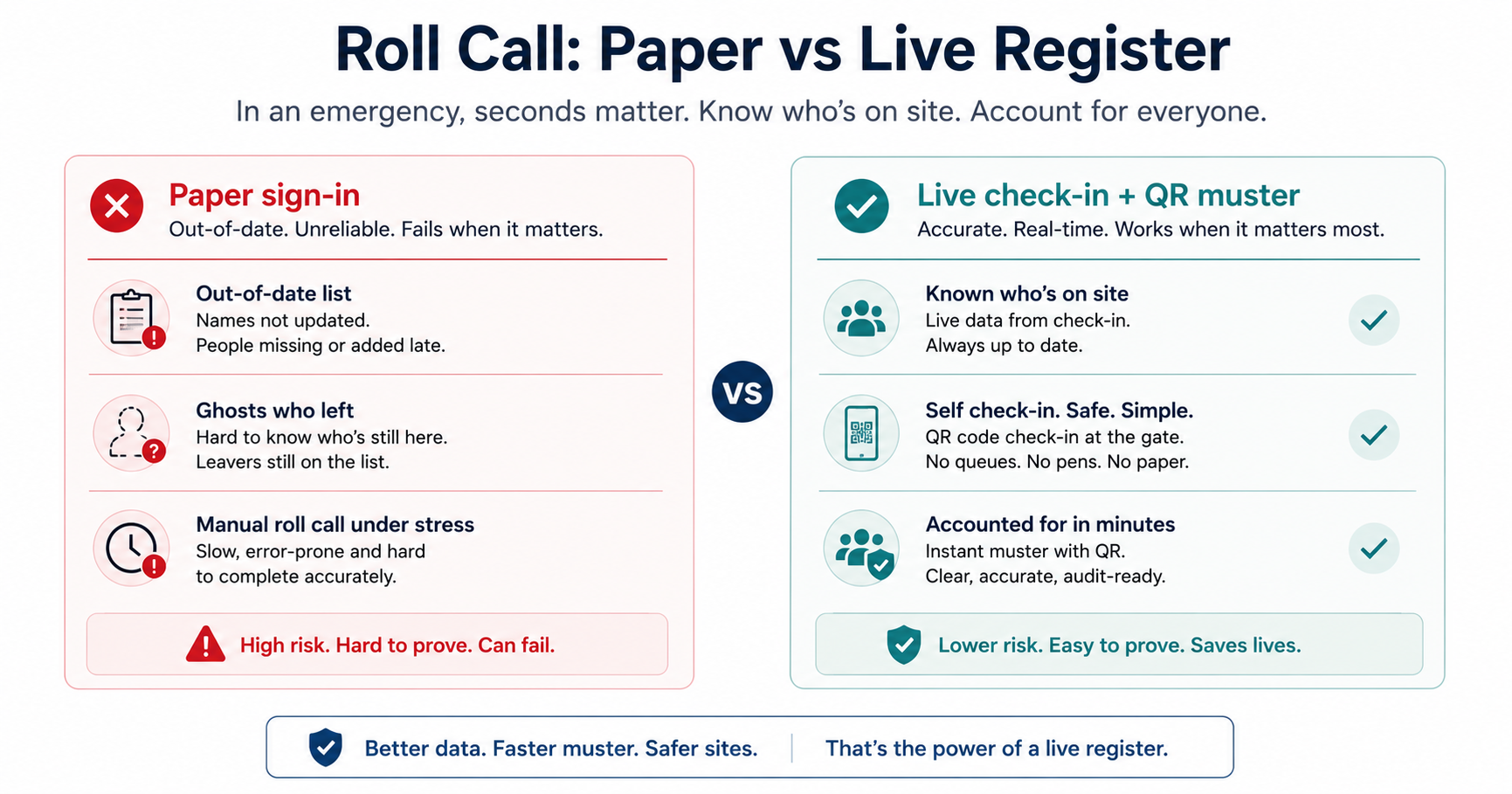
The Roll Call — and Why Paper Fails Under Stress
At the assembly point, accountability happens through a roll call against the register — fire wardens checking names, supervisors accounting for their teams, a designated warden coordinating across muster points and reporting to the incident controller.
The critical design rule: the system must be simple enough to execute reliably under stress. Overly complex procedures — multiple paper lists, unclear reporting lines, dependence on a specific individual who may not be present that day — tend to fail exactly when they're needed most. A wet, wind-blown paper register, a warden who's off site, or a sign-in book that doesn't reflect who actually left: any of these turns a roll call into guesswork during an emergency.
This is precisely where a live, digital record of who is currently on site changes the picture. If check-in and check-out are captured reliably — ideally tied to site access rather than a voluntary signature — the muster-point roll call becomes a check against known data rather than a scramble to reconstruct who might be inside.
Choosing and Maintaining the Assembly Point
The FSO doesn't specify exact distances, but the assembly point must be appropriate for the building, its occupants, and the risks. Practical requirements:
- A safe distance clear of falling debris, smoke, and structural collapse risk.
- Visible and accessible from the main exits, with clear, consistent signage.
- Clear of emergency-service access, so a crowd doesn't obstruct responders.
- A backup assembly point predetermined in case the primary is unreachable.
Because sites change constantly — new structures, altered access routes, changed occupancy — a previously suitable assembly point can become unsuitable. The responsible person has an ongoing duty to review it as part of the fire risk assessment and whenever a material change occurs, and to communicate any change through updated procedures, signage, and training.
Training Everyone — Including Temporary Workers
The Article 21 fire safety training duty extends explicitly to evacuation procedures — and to all staff, including part-time, temporary, and agency workers. Everyone on site must know the location of the assembly point and what to do when they get there.
On a construction site this loops directly back to induction: the site induction is where evacuation procedures, alarm signals, escape routes, and the assembly point are communicated, and it must reach every worker regardless of how they're engaged. Regular drills then test whether the training and the roll-call system actually work — and reveal register weaknesses before a real emergency does. A worker who was inducted but can't name the assembly point is the same gap as a register that can't account for them. For how induction evidence is checked, see site induction records; for temporary labour, see managing agency and temporary workers' compliance.
Why This Matters for UK Construction in 2026
Failure to have appropriate, demonstrable evacuation arrangements can bring enforcement action, and where injuries or fatalities result from poor emergency planning, the consequences escalate to prosecution. With the Building Safety Act reinforcing the duty to keep safety arrangements current and demonstrable, and construction fire risk under close scrutiny, being able to prove that you knew who was on site and could account for them is central — not peripheral.
The through-line is the same as every other construction compliance duty: it's judged on demonstrable evidence, not intention. "We have an assembly point" is not the standard; "we can account for everyone on site within minutes, and prove our arrangements and training are current" is.
Know Who's On Site — and Account for Everyone Fast
TrainMeUK's Site Management gives you a live record of who's checked in, plus QR muster-point check-in so people can mark themselves safe in an evacuation — turning the roll call into a check against known data.
How TrainMeUK Helps
TrainMeUK's Site Management module is built around the "who's on site" problem. QR-based site check-in creates a live record of who is currently on site, rather than relying on a voluntary paper sign-in that people forget to complete — and because access can be tied to that check-in, the record reflects who actually entered.
For evacuations, QR muster-point check-in lets workers mark themselves safe at the assembly point, so accountability becomes a check against a known, live list rather than a manual roll call against a register that may be out of date. Because the same system also handles induction and required credentials, evacuation procedures can be delivered and recorded as part of onboarding, reaching every worker including temporary and agency staff. You set the site rules, assembly arrangements, and induction content; the platform keeps the live record and captures who checked in, who's accounted for, and who completed the training. (The physical assembly-point selection, drills, and fire risk assessment remain your on-site responsibility — the platform provides the live record and the accountability tooling.)
Final Takeaway
A fire plan is only as good as your answer to one question, asked at the worst possible moment: who's still inside? Get the register right and the roll call right, and everything else in your fire plan finally has something solid to stand on.
Related Articles
How to Build a Construction Training Matrix
The record structure behind site access.
Read More →Site Induction Records
Where evacuation procedures are communicated.
Read More →Best Construction LMS Software UK
Which platforms can account for people still on site.
Read More →Agency & Temporary Workers' Compliance
Reaching a churning workforce with fire training.
Read More →Frequently Asked Questions
Is a roll call legally required after a construction site evacuation?
The law doesn't prescribe a specific "roll call" method, but the Regulatory Reform (Fire Safety) Order 2005 requires the responsible person to have appropriate procedures for serious and imminent danger, and accounting for everyone is the core purpose of an assembly point. In practice this means being able to confirm everyone who was on site has evacuated — whether through a warden's roll call against an up-to-date register, supervisors accounting for their teams, or a digital check-in system. What matters is that the arrangement is suitable and that you can demonstrate it works.
Who is the "responsible person" for fire safety on a construction site?
Under the Fire Safety Order, the responsible person is generally the employer or whoever has control of the premises. On a construction site this typically means the principal contractor or the party in control of the site, who must ensure suitable evacuation procedures, adequate fire safety training, and appropriate assembly arrangements. The responsibility can't be signed away with paperwork — it follows control of the premises — and the responsible person must be able to demonstrate the arrangements are appropriate if challenged by an enforcing authority.
How do you account for everyone on a construction site during an evacuation?
You account for people by conducting a roll call at the assembly point against a register of who is on site — which means the register has to be accurate at the moment the alarm sounds. This is the hard part on construction sites, because the workforce changes constantly and manual sign-in books are often out of date, especially when people forget to sign out. A live check-in system tied to site access, plus a way for workers to mark themselves safe at the muster point, makes accountability far more reliable than a paper roll call.
Do agency and temporary workers need fire and evacuation training?
Yes. The fire safety training duty under Article 21 of the Fire Safety Order applies to all staff, explicitly including part-time, temporary, and agency workers. Everyone on site must know where the assembly point is and what to do when the alarm sounds, which is why evacuation procedures are covered in the site induction that every worker must receive. A temporary worker who wasn't briefed on the assembly point is both a safety risk and a compliance gap.
How often should the assembly point be reviewed?
The assembly point should be reviewed as part of every fire risk assessment and additionally whenever there's a material change to the site, building, or occupancy — which on a construction site happens frequently as new structures go up, access routes change, and occupancy levels shift. A location that was suitable at the start of a project can become unsuitable later, so the responsible person has an ongoing duty to check it remains appropriate and to communicate any change through updated procedures, signage, and training.
Turn the Roll Call into a Live Headcount
See how TrainMeUK's Site Management tracks who's on site and lets workers mark themselves safe at the muster point via QR check-in.
Sources: Regulatory Reform (Fire Safety) Order 2005; HSE — HSG168 Fire Safety in Construction; CDM Regulations 2015; Building Safety Act 2022.